NSDC Courses vs SIDH Portal Courses 2026: Key Differences
Looking to learn new skills in 2026? Discover the differences between NSDC courses and SIDH Portal courses, their benefits, certification options and how to select the right learning path for your career.
Learning a new skill can make a real difference when you are searching for your first job, preparing for an internship, or trying to move into a better career. In 2026, students and job seekers in India have several online skill-development options, including courses connected with the National Skill Development Corporation (NSDC) and the Skill India Digital Hub (SIDH).
However, many learners are unsure about the difference between NSDC courses and SIDH Portal courses. Are they the same? Which platform offers free courses? Will you receive a certificate after completing a course? And which option is better for your career?
The most important point to understand is that NSDC is an organisation involved in India's skill-development ecosystem, while SIDH is a digital platform designed to bring skill-development services and opportunities together. Their roles can overlap, so comparing individual courses is more useful than assuming that every course on one platform is completely different from every course on the other.
What Are NSDC Courses?
The National Skill Development Corporation (NSDC) works to support and strengthen skill development in India by collaborating with training providers, industry partners and other organisations. Its wider ecosystem includes vocational training, industry-oriented learning, digital courses and initiatives connected with the Skill India mission.
When people talk about NSDC courses, they may mean courses delivered through an NSDC-supported programme, training provided by an affiliated organisation, or online learning available through an NSDC-related digital platform. The exact course structure depends on the programme and training provider.
NSDC's eSkill India initiative provides access to digital learning resources from multiple knowledge partners. Learners can explore subjects that include technical skills, communication, information technology and other areas relevant to employment and professional development.
Official website: NSDC eSkill India
Key Features of NSDC-Related Courses
- Industry-focused learning: Many programmes aim to develop skills that are useful in particular sectors and job roles.
- Different learning formats: Depending on the programme, training may be online, classroom-based or delivered through a blended format.
- Multiple subject areas: Available options may cover information technology, business, communication, vocational skills and other professional fields.
- Training-provider involvement: Some programmes are delivered by partner organisations or training centres rather than directly by NSDC.
- Course-specific certification: Assessment and certificate rules depend on the particular course, awarding organisation and programme requirements.
Before enrolling, check the name of the training provider, the syllabus, the duration, the assessment method and the organisation that will issue the certificate. The word “NSDC” alone does not mean that every course has identical recognition or certification conditions.
What Are SIDH Portal Courses?
SIDH stands for Skill India Digital Hub. It is a government-backed digital platform launched in September 2023 to connect learners with skill-development opportunities and related services through a common online system.
The portal helps users discover courses across different schemes and training providers. Depending on the listing, learners may find online courses, vocational training opportunities and programmes related to particular skills or career areas. The platform also supports digital enrolment and certification-related services for eligible programmes.
SIDH aims to make it easier for candidates to discover training opportunities without having to search through many separate websites. Its wider ecosystem also connects skill development with services such as employment and other government platforms.
Official portal: Skill India Digital Hub
Key Features of SIDH Courses
- Course discovery: Learners can search for available skill courses and explore their details.
- Different providers: Course listings may be offered by different organisations, institutions or industry partners.
- Online access: Some courses can be completed online, including self-paced options.
- Course-specific requirements: Eligibility, language, duration and assessment rules vary from one listing to another.
- Digital services: The platform supports digital processes related to enrolment and credentials for relevant programmes.
- Career-related opportunities: SIDH is part of a broader ecosystem that connects skill development with employment and other opportunities.
For example, the SIDH portal has listed online learning options in areas such as artificial intelligence, cloud computing, cybersecurity, digital marketing and software development. Availability and course conditions can change, so check the live listing before applying.
NSDC Courses vs SIDH Portal Courses 2026: Main Differences
The main difference is their role in the skill-development ecosystem. NSDC is an organisation that supports skill-development initiatives and works with training partners. SIDH is a digital hub that brings together course discovery and other skill-related services.
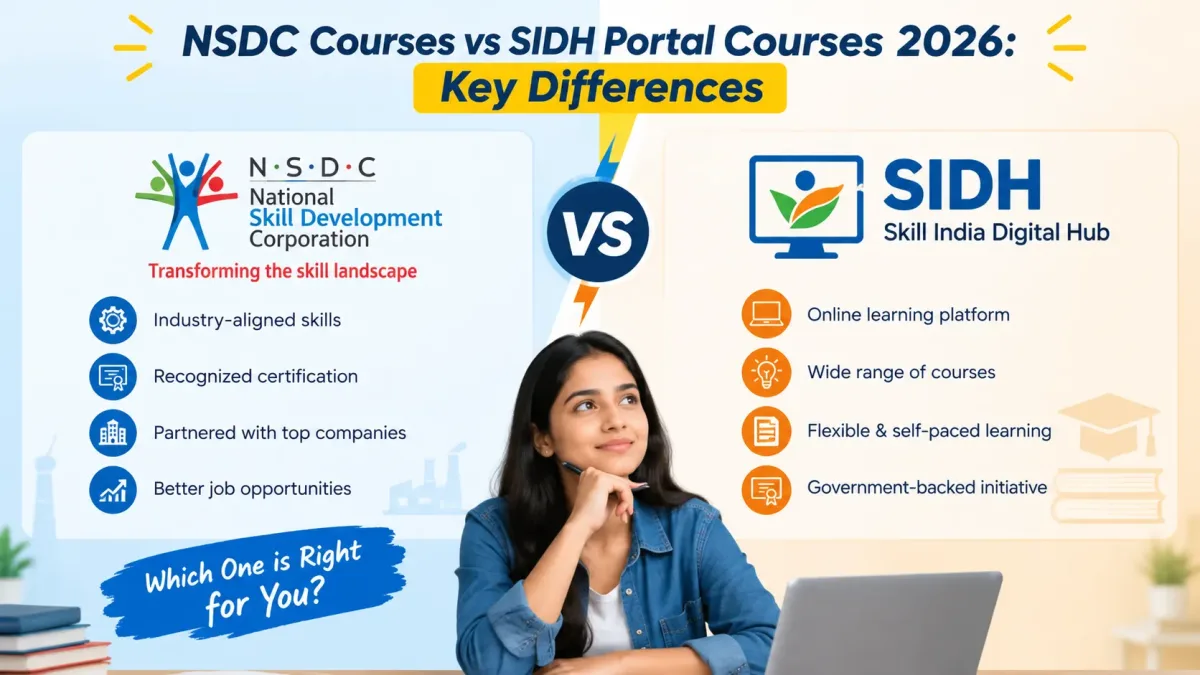
Comparison Point NSDC-Related Courses SIDH Portal Courses Meaning Courses delivered through NSDC initiatives, related digital platforms or relevant training partners Courses and opportunities discoverable through the Skill India Digital Hub Main role Supports the wider skill-development ecosystem and works with training partners Provides a digital entry point for discovering skill-development opportunities Course providers May include partner organisations, training centres and digital learning providers Can include multiple providers and programmes listed on the portal Learning format Online, classroom-based or blended, depending on the programme Online or other training formats, depending on the listed opportunity Course fees May be free or paid, depending on the course and scheme Some courses are free; others may have different conditions Eligibility Set by the particular course, provider or scheme Set by the particular listing, provider or scheme Certificate Depends on the course, assessment and issuing organisation Depends on the course, assessment and issuing organisation Best use Finding a relevant NSDC-linked learning or training opportunity Exploring different skill courses and opportunities in one digital hubImportant: These are not always two separate types of courses. An NSDC-supported programme or a course delivered by a partner may also appear within a wider digital skilling ecosystem. Always compare the actual course details rather than relying only on the platform name.
Are NSDC and SIDH Courses Free in 2026?
Some courses available through these platforms are free, but you should not assume that every course is free. Fees depend on the course provider, funding arrangement, scheme and type of training.
Before you register, look for the following information on the official course page:
- Whether the course fee is listed as free or paid.
- Whether registration, examination or certificate charges apply.
- Whether the course is fully online or requires attendance at a training centre.
- Whether any financial support is available under a specific scheme.
- Whether you must meet age, education, location or other eligibility requirements.
If a third-party website advertises a course as free, verify the claim on the official platform or with the listed training provider before sharing documents or making a payment.
What About Certificates and Job Opportunities?
A course certificate can help demonstrate that you have studied a subject or completed a training programme. However, its value depends on the course content, assessment, issuing organisation and relevance to the job you want.
Do not assume that every course automatically provides an NSDC certificate or a government-recognised qualification. Some courses offer a certificate of completion, while other programmes may involve formal assessments or qualification requirements. Read the certificate details before enrolling.
Similarly, completing an NSDC-related or SIDH-listed course does not guarantee a job. Employers may also look at practical knowledge, communication, work samples, experience and interview performance.
How to Make Your Certificate More Useful
- Choose a course that matches the role you want to pursue.
- Complete the lessons, assignments and assessments honestly.
- Build a small project or practical example using what you learned.
- Add the course to your resume with the correct provider and completion details.
- Keep the certificate and course information available for verification.
How to Find and Apply for Courses on the SIDH Portal
If you want to explore courses through the Skill India Digital Hub, follow these general steps. The exact screens and requirements may change as the portal is updated.
- Visit the official website: Open skillindiadigital.gov.in.
- Register or sign in: Follow the instructions for creating an account or accessing an existing one.
- Complete verification if required: The portal may ask for identity verification or other details for particular services or schemes. Use only the official website and follow its instructions.
- Search for a course: Explore subjects such as IT, AI, digital marketing, business or vocational training.
- Read the course page: Check the provider, eligibility, language, duration, fee, assessment and certificate details.
- Apply or enrol: Follow the instructions shown for that specific course.
- Track your progress: Use the portal or provider's instructions to access learning materials and check completion requirements.
For additional help, NSDC has published a candidate registration and enrolment guide: SIDH candidate registration and enrolment process.
How to Choose the Right Course for Your Career
The best course is not necessarily the one with the most popular name. It is the one that helps you build a skill you can actually use.
For College Students
Students can look for beginner-friendly courses that complement their studies. Computer science students, for example, may explore programming, cloud computing, cybersecurity, data analysis or AI fundamentals. Choose a course with practical exercises rather than relying only on videos.
For Freshers and Job Seekers
Freshers should prioritise skills mentioned in job descriptions for their target roles. Communication, spreadsheets, customer support, digital marketing, coding and industry-specific skills may be useful depending on the career path. A course that includes assignments or a project can help you demonstrate your abilities.
For Working Professionals
Professionals may benefit from short upskilling courses that address a clear gap in their current role or prepare them for a new one. Check the course level and time commitment before starting.
For Vocational and Practical Training
If you want a hands-on occupation, look for programmes that explain the practical training, assessment process and training-centre location. An online introduction may be helpful, but it might not replace supervised practical training when the job requires it.
Advantages and Limitations to Consider
NSDC-Related Courses
- Advantages: May provide access to industry-linked training, vocational programmes and digital learning from partner organisations.
- Limitations: Course quality, fees, format and certificate conditions can differ between providers and programmes.
SIDH Portal Courses
- Advantages: Makes it easier to discover different skill-development opportunities through a common digital platform.
- Limitations: You still need to read each listing carefully, and not every course will suit your education level, location or career goal.
In both cases, check the syllabus, instructor or provider information, course duration, practical work, assessment and certificate conditions before making a decision.
Frequently Asked Questions (FAQs)
1. What is the difference between NSDC courses and SIDH courses?
NSDC is an organisation involved in India's skill-development ecosystem, while SIDH is a digital hub for discovering courses and related opportunities. NSDC-linked programmes and partner offerings may overlap with the wider SIDH ecosystem.
2. Are SIDH Portal courses free in 2026?
Some SIDH-listed courses are free, while other opportunities may have fees or specific conditions. Check the individual course page for the latest information.
3. Can college students apply for SIDH courses?
Students can explore available courses, but eligibility depends on the individual programme. Check whether the course has educational, age or other requirements before applying.
4. Do NSDC courses provide certificates?
Certification depends on the course and programme. Confirm who issues the certificate, whether an assessment is required and what type of completion credential is provided.
5. Are SIDH certificates valid for government jobs?
Do not assume that every SIDH course certificate meets the requirements of a government recruitment process. The recruiting authority decides which qualifications or certificates are accepted. Read the relevant recruitment notification carefully.
6. Which is better for IT students: NSDC or SIDH?
Neither is automatically better for every IT student. Compare the actual courses in programming, cloud computing, cybersecurity, data science or AI. Choose the one that offers suitable content, practical learning and clear certificate conditions.
7. Does completing a course guarantee a job?
No. A course can help you develop skills, but employment depends on factors such as your practical ability, qualifications, experience, interview performance and employer requirements.
8. Where can I check official course details?
Visit the NSDC eSkill India website and the Skill India Digital Hub. Always verify course information with the official listing or provider.
Final Thoughts and Key Takeaways
When comparing NSDC Courses vs SIDH Portal Courses in 2026, remember that the two names describe different parts of India's skill-development ecosystem. NSDC supports training initiatives and works with partners, while SIDH helps learners discover courses and access related digital services.
For students and job seekers, the smartest approach is to compare individual courses based on their content, practical learning, eligibility, fees and certificate details. A free course can be a good starting point, but its usefulness depends on what you learn and how you apply that knowledge.
Before enrolling, use the official websites, read the course conditions carefully and choose training that supports your career goal. Learn consistently, practise your skills and build projects or work samples that show what you can do.
For more updates on skill development, internships, online courses and career opportunities, keep visiting TechNaukary.