How to Land Your First IT Job in 2026 Without a Tier-1 College Tag
Studying at a Tier-2 or Tier-3 college does not mean your IT career has to start with limitations. Learn how to develop job-ready skills, build impressive projects, prepare for interviews and find your first IT opportunity in 2026.
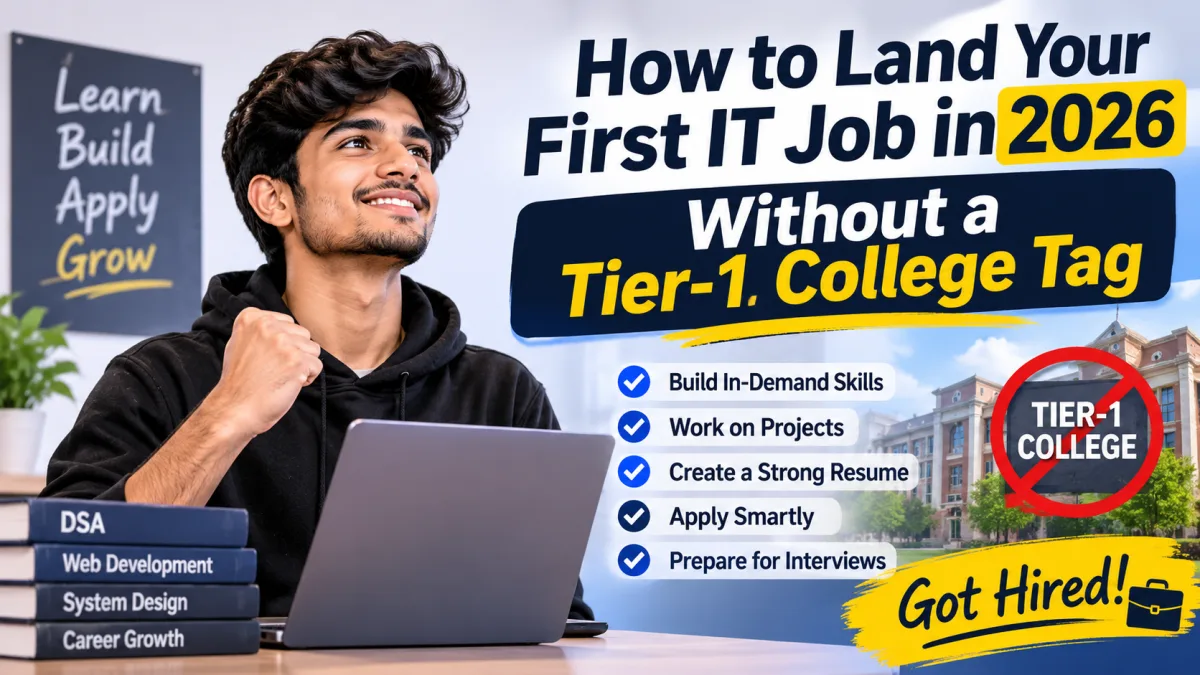
Let's be honest. When students begin looking for their first IT job, one question often comes to mind: "Will companies hire me if I am not from an IIT, NIT or another top-ranked college?"
It is a genuine concern. Students from well-known institutions may have access to established placement cells, campus recruitment drives, alumni networks and opportunities to connect with major companies. Meanwhile, students from smaller colleges sometimes have to search for opportunities themselves.
But here is something worth remembering: your college name may influence your first opportunity, but it does not have to decide your entire career.
Thousands of students study at Tier-2 and Tier-3 engineering colleges across India. Many of them go on to become software developers, testers, cloud engineers, analysts and technology professionals. Their journey may require extra effort, but it is absolutely possible to build a strong career without a famous college name.
The IT industry is competitive in 2026, and getting that first opportunity is not always easy. A report analysing 18,752 Indian technology job postings from September to October 2026 found that only 4.3% were tagged as entry-level or junior roles. This shows why freshers need to be prepared rather than relying only on their degree or placement season.
The good news is that you can take practical steps to improve your chances. You can develop relevant technical skills, create projects, gain experience through internships and apply directly to companies.
In this guide, we will explain how to approach your first IT job search, even if your college does not have a big placement reputation.
1. Understand What Companies Actually Look for in Freshers
One common mistake students make is assuming that companies only select candidates from famous colleges. While some organisations have specific campus recruitment requirements, many other employers hire through online applications, referrals, coding assessments and direct interviews.
When companies recruit freshers, they generally want to understand whether a candidate has the foundation needed to learn and contribute to the team.
Depending on the role, recruiters and interviewers may evaluate:
- Technical knowledge: Do you understand the programming language or technology mentioned in the job description?
- Problem-solving ability: Can you break a problem into smaller steps and develop a logical solution?
- Project experience: Have you built something beyond classroom assignments?
- Communication: Can you explain your ideas and discuss technical problems clearly?
- Learning attitude: Are you willing to understand new tools and improve your skills?
- Professional behaviour: Can you work responsibly, accept feedback and collaborate with others?
A degree provides your educational foundation, but employers also want evidence that you can apply what you have learned.
For students from smaller colleges, this is an important opportunity. You may not be able to change your college name, but you can improve your skills, projects and interview preparation.
2. Choose One Career Path Instead of Learning Everything
Open YouTube or LinkedIn and you will find hundreds of suggestions: learn Java, become a Python developer, study artificial intelligence, master cloud computing, learn cybersecurity, become a data analyst and much more.
Trying to learn everything at once can leave you with a little knowledge of many technologies but no confidence in any particular area.
Instead, choose one career direction and build your preparation around it.
Popular IT career paths for freshers in 2026
Career Path Important Skills Possible Entry-Level Roles Frontend Development HTML, CSS, JavaScript, React Frontend Developer, Web Developer Backend Development Java, Python, Node.js, APIs, SQL Backend Developer, Software Engineer Trainee Full-Stack Development React, Node.js, databases, REST APIs Junior Full-Stack Developer Data Analytics Excel, SQL, Python, Power BI Junior Data Analyst, Reporting Analyst Software Testing Manual Testing, SQL, Selenium, API Testing QA Tester, Test Engineer Trainee Cloud and DevOps Linux, Git, Docker, AWS or Azure Cloud Support Associate, DevOps Trainee Cybersecurity Networking, Linux, security fundamentals Security Analyst Trainee, SOC AnalystYou do not need to choose the trendiest field. Choose the one that matches your interest and where you are willing to practise consistently.
For example, if you enjoy building websites, frontend or full-stack development may be a good starting point. If you like working with numbers and finding patterns, data analytics may suit you better.
3. Build Strong Programming Fundamentals
If your goal is to become a software developer, do not rush directly into advanced frameworks. First, understand the fundamentals of programming.
Many students know how to follow a tutorial and create an application, but struggle when an interviewer asks them to solve a simple problem without guidance.
That is why your preparation should include the following topics:
Programming language
Choose one main language such as Java, Python, C++ or JavaScript. Understand variables, data types, loops, functions, arrays, strings, object-oriented programming and exception handling.
Data Structures and Algorithms
Practise arrays, strings, linked lists, stacks, queues, hash maps, trees, sorting and searching. Start with easy questions and gradually move towards medium-level problems.
Database and SQL
Learn how databases work. Practise writing SELECT, INSERT, UPDATE and DELETE queries. Understand joins, primary keys, foreign keys, grouping and basic database design.
Computer Science Fundamentals
Prepare the basics of operating systems, computer networks, DBMS and object-oriented programming. These subjects frequently appear in technical interviews for software-related roles.
You do not need to solve hundreds of difficult coding problems before applying. What matters is developing a reliable understanding of the basics and learning how to approach unfamiliar questions.
4. Build Two or Three Real Projects That Solve Problems
This is one of the most important steps for students who do not have access to strong campus placements.
Your resume may say that you know React, Java, Python or SQL. However, a project gives an interviewer a chance to see how you have used those technologies.
Do not fill your GitHub profile with ten copied tutorial projects. Instead, build two or three useful applications that you can explain confidently.
Project ideas for software development freshers
1. Job Application TrackerCreate an application that allows users to save job applications, track interview dates, update application statuses and organise company information.
Possible technologies: React, Node.js, Express and MongoDB.
2. Student Management SystemBuild a system to manage student details, attendance, marks and academic records. Add authentication and different access levels for administrators and students.
Possible technologies: Java, Spring Boot, MySQL and React.
3. Personal Finance TrackerCreate an application that allows users to record income and expenses, organise transactions into categories and view monthly spending reports.
Possible technologies: Python, FastAPI, PostgreSQL and React.
4. Online Learning PlatformBuild a simple platform where students can register, browse courses, access learning materials and track their progress.
Possible technologies: Next.js, Node.js, MongoDB or PostgreSQL.
5. AI-Powered Resume CheckerCreate a tool that compares a resume with a job description, identifies missing skills and suggests improvements. Make sure the results are presented as guidance rather than guaranteed ATS scores.
Possible technologies: Python, NLP libraries, FastAPI and React.
What makes a project impressive?
- It solves a clearly defined problem.
- It has a working frontend and backend where required.
- It uses a database properly.
- It includes input validation and basic error handling.
- It has a clean and understandable user interface.
- It is uploaded to GitHub with a useful README file.
- It includes screenshots or a working live demonstration where possible.
Most importantly, understand your own code. An interviewer may ask why you selected a particular database, how authentication works or what happens when an API request fails. Be prepared to explain your decisions.
5. Create a Professional GitHub Profile and Portfolio
Your GitHub profile can act as a public record of your development journey. It allows recruiters and technical interviewers to explore your projects, code structure and development activity.
However, simply creating a GitHub account is not enough. Make it useful and professional.
Here are some practical improvements:
- Use a professional username and profile photo if you are comfortable doing so.
- Add a short introduction describing your technical interests.
- Pin your two or three strongest projects.
- Write a README file for each important project.
- Include installation instructions and technologies used.
- Upload meaningful code instead of empty repositories.
- Keep your repositories organised and remove unnecessary files.
You can also create a simple portfolio website with your introduction, technical skills, projects, resume and contact information.
You do not need an expensive domain or a complicated design. A clean, working portfolio is enough to help people understand your work.
Useful platforms:
- GitHub – Host and showcase your code.
- Vercel – Deploy frontend and web applications.
- Netlify – Host websites and frontend projects.
- LinkedIn – Build your professional network.
6. Make Your Resume Strong Even Without a Famous College
Your resume is often the first introduction a recruiter has to you. If it is unclear, too long or filled with unnecessary information, your actual skills may get overlooked.
For a fresher, a clean one-page resume is usually a practical choice.
What should your fresher resume include?
- Contact information: Name, professional email, phone number, LinkedIn and GitHub links.
- Career summary: Two or three lines explaining your technical interests and strengths.
- Technical skills: Programming languages, frameworks, databases and development tools you genuinely know.
- Projects: Mention the problem, technologies used and your contribution.
- Internships: Include relevant work experience, responsibilities and achievements.
- Education: Degree, college, graduation year and academic details requested by the employer.
- Certifications and achievements: Add relevant credentials and measurable accomplishments.
Example of a better project description
Weak description: Created a website using React and MongoDB.
Stronger description: Developed a job application tracking platform using React, Node.js and MongoDB, allowing users to manage applications, update interview statuses and organise job opportunities through a responsive dashboard.
The second version gives the recruiter a clearer picture of what you actually built.
Be honest about your contribution. Never add technologies to your resume just because they appear in a job description. You may be asked questions about every skill you mention.
7. Do Not Depend Only on Campus Placements
If your college does not attract many IT companies, waiting for placement season can limit your opportunities.
Start applying independently. Many companies publish vacancies on their career pages and job platforms. Some also recruit through referrals, internships, coding assessments and direct applications.
Look for these types of opportunities:
- Software Developer Intern
- Frontend Developer Intern
- Backend Developer Intern
- Graduate Engineer Trainee
- Junior Software Engineer
- QA Engineer Trainee
- Technical Support Engineer
- Application Support Associate
- Data Analyst Intern
- Cloud Support Associate
Where should you search for IT jobs?
- LinkedIn Jobs
- Naukri
- Foundit
- Internshala
- Wellfound
- Indeed
- TCS Careers
- Infosys Careers
- Wipro Careers
- HCLTech Careers
Do not search only for jobs labelled "fresher." Try terms such as "graduate trainee," "junior developer," "associate software engineer," "entry-level QA" and "developer intern."
Read the eligibility criteria carefully. Some companies specify graduation years, degree branches, academic percentages or other conditions. Apply when you meet the stated requirements.
8. Use LinkedIn to Build Connections, Not Just Apply for Jobs
LinkedIn can be useful for discovering vacancies, learning about companies and connecting with people working in your target field.
But sending hundreds of generic connection requests is not a good networking strategy. Focus on building genuine professional connections.
How to use LinkedIn effectively
- Complete your profile with a clear headline and relevant skills.
- Add your strongest projects with descriptions and working links.
- Follow companies that recruit for your target role.
- Connect with developers, recruiters, alumni and professionals.
- Share project updates and what you learn while building applications.
- Engage thoughtfully with useful technical posts.
- Ask for advice instead of immediately demanding a job referral.
Example LinkedIn connection message
"Hello, I am a computer science student interested in software development. I came across your profile and noticed your experience in the industry. I am currently improving my skills through projects and interview preparation. I would be happy to connect and learn from your professional journey."
Keep your message short and respectful. A referral is never guaranteed, but a genuine connection can help you understand the industry and discover opportunities.
9. Prepare for Technical and HR Interviews
Getting shortlisted is only one part of the process. You also need to perform well in assessments and interviews.
Students sometimes spend months learning technologies but avoid practising how to explain their knowledge. This becomes a problem when an interviewer asks them to describe a project or solve a basic programming question.
Technical interview preparation
Depending on your target role, prepare these areas:
- One programming language in depth.
- Arrays, strings and basic data structures.
- Object-oriented programming concepts.
- SQL queries and database fundamentals.
- Operating systems and computer networks basics.
- Project architecture and technical decisions.
- Basic coding problems and logical reasoning.
Common HR interview questions
- Tell me about yourself.
- Why did you choose this company?
- Why should we hire you?
- What are your strengths and weaknesses?
- Explain your favourite academic or personal project.
- Are you comfortable learning new technologies?
- Where do you see yourself in the next three years?
How to answer the college-related question
If an interviewer asks about your college or its placement opportunities, do not become defensive or speak negatively about your institution.
You can respond with confidence:
"I come from a college where I have had to take responsibility for much of my own technical learning. I used that opportunity to strengthen my programming fundamentals, work on practical projects and improve my problem-solving skills. I understand that I am at the beginning of my professional journey, and I am ready to learn and contribute."
Your answer should reflect your real experience. Confidence comes from preparation, not from pretending that you know everything.
10. Apply Smartly and Track Every Application
Sending the same resume to every company is rarely an effective strategy. A better approach is to apply for roles that match your skills and make small adjustments to your resume where necessary.
For example, if you are applying for a Java developer role, highlight Java, OOP, SQL, Spring Boot and relevant projects. If you are applying for a frontend position, bring React, JavaScript, HTML, CSS and UI projects forward.
Create a simple job application tracker with these columns:
- Company name
- Job role
- Application date
- Job link
- Required skills
- Application status
- Follow-up date
- Interview notes
This helps you avoid duplicate applications and understand which roles are generating responses.
Apply consistently, but do not sacrifice application quality just to increase the number of submissions. Also be careful of fake recruiters, suspicious interview links and anyone asking for money in exchange for a guaranteed job.
11. A Practical 90-Day Roadmap to Get Your First IT Job
If you are confused about where to begin, use this 90-day plan as a starting point. Adjust the schedule according to your college timetable, existing knowledge and target role.
Time Period Main Focus What You Should Complete Days 1–15 Choose a career path Select one target role, study job descriptions and identify the skills you need. Days 16–30 Build fundamentals Practise programming, SQL, basic DSA and role-specific concepts. Days 31–45 Project development Build your first practical project and upload the code to GitHub. Days 46–60 Portfolio and resume Improve your project, write documentation, create a portfolio and prepare your resume. Days 61–75 Interview preparation Practise coding questions, technical concepts and HR interview answers. Days 76–90 Job applications Apply for relevant jobs and internships, connect with professionals and attend interviews.Important: This is a preparation roadmap, not a promise that you will receive a job offer within 90 days. Hiring timelines depend on vacancies, eligibility, competition and your preparation level. Continue applying and improving after the plan ends.
12. Mistakes That Can Delay Your First IT Job
Sometimes students are working hard but not moving forward because their preparation is not focused. Avoid these common mistakes:
Learning too many technologies
Jumping from Java to Python, then React, then machine learning without completing anything can create confusion. Build depth in one career path first.
Copying projects without understanding them
Following tutorials is useful when you are learning, but submitting copied projects as your own work can create problems during interviews. Add your own features and understand the implementation.
Waiting until final year to prepare
Start building skills and projects as early as possible. Even a small project completed during college can become useful interview material.
Ignoring communication skills
You do not need perfect English to become a developer. However, you should be able to explain your work, ask questions and communicate professionally.
Applying only to large companies
Do not ignore startups, small software companies, IT service providers and local technology businesses. A relevant first job can provide experience that helps you compete for future opportunities.
Believing every online job promise
Be cautious of courses, consultants or individuals promising guaranteed jobs in exchange for large payments. Verify the company and recruitment process before sharing personal information or money.
Frequently Asked Questions (FAQs)
1. Can I get an IT job without studying at an IIT or NIT?
Yes. Many IT employers recruit through off-campus applications, referrals, internships and technical assessments. A Tier-1 college background can provide certain advantages, but it is not a universal requirement for software and technology jobs.
2. Can a Tier-3 college student get a software developer job in 2026?
Yes. Students from Tier-3 colleges can apply for software developer roles if they meet the employer's eligibility criteria and demonstrate relevant programming knowledge, problem-solving ability and project experience.
3. Which programming language should freshers learn first?
Java, Python, C++ and JavaScript are all useful choices. Select one based on your target career path and learn its fundamentals properly before moving to advanced frameworks.
4. How many projects should I include in my resume?
For most freshers, two or three well-developed and relevant projects are a good starting point. Quality matters more than quantity. Be prepared to explain the code, architecture and decisions behind each project.
5. Is DSA necessary for every IT job?
Data Structures and Algorithms are particularly important for many software development interviews. Other roles, such as testing, IT support and data analytics, may place greater emphasis on different technical skills. Check the requirements of your target position.
6. Can I get an IT job without an internship?
Yes. An internship is helpful because it provides practical exposure, but it is not compulsory for every fresher role. Personal projects, open-source contributions, academic work and other relevant experience can also strengthen your profile.
7. Should I apply to startups as a fresher?
Yes, provided the role and company are legitimate and the responsibilities match your goals. Startups may offer opportunities to work on practical tasks, but research the organisation and understand the job conditions before accepting an offer.
8. Is a certification enough to get a job?
Usually not. A certification can validate knowledge in a particular area, but employers may also evaluate practical skills, projects, experience and interview performance.
9. What if I have a low CGPA or academic gaps?
Check each company's eligibility rules because some employers have minimum academic requirements. Where you are eligible, focus on demonstrating your skills and explaining your academic journey honestly. Do not hide or misrepresent your records.
10. How long does it take to get the first IT job?
There is no fixed timeline. It depends on your starting skill level, target role, location, hiring conditions and consistency. Some candidates find opportunities quickly, while others need several months of preparation and applications.
Final Thoughts and Key Takeaways
Not studying at a Tier-1 college does not mean you should lower your career ambitions. It simply means you may need to be more proactive about finding opportunities, building your skills and demonstrating your abilities.
Do not spend your college years worrying about a label that you cannot change. Focus on the things that are within your control: learn one programming language properly, practise problem-solving, build useful projects, improve your resume and prepare for interviews.
Start applying before you feel completely ready. You will learn from coding assessments, interview questions and even rejections. If you do not clear an interview, identify the areas where you struggled and work on them before the next opportunity.
Also remember that your first IT job does not have to be your dream job. A genuine entry-level opportunity can help you gain experience, understand professional development practices and discover which direction you want to follow.
Your college may be part of your introduction, but your skills, attitude and work will continue to shape your professional journey.
At TechNaukary, we believe that every student deserves access to useful career guidance and learning opportunities, regardless of their college background. Keep learning, keep building and keep applying. Your first opportunity may be closer than you think.