AI Jobs for Freshers 2026: Roles, Skills & Salary
Looking for AI jobs for freshers in 2026? Learn which entry-level AI roles you can target, what skills companies expect, what projects to build, how much freshers may earn, and how to get your first AI job.
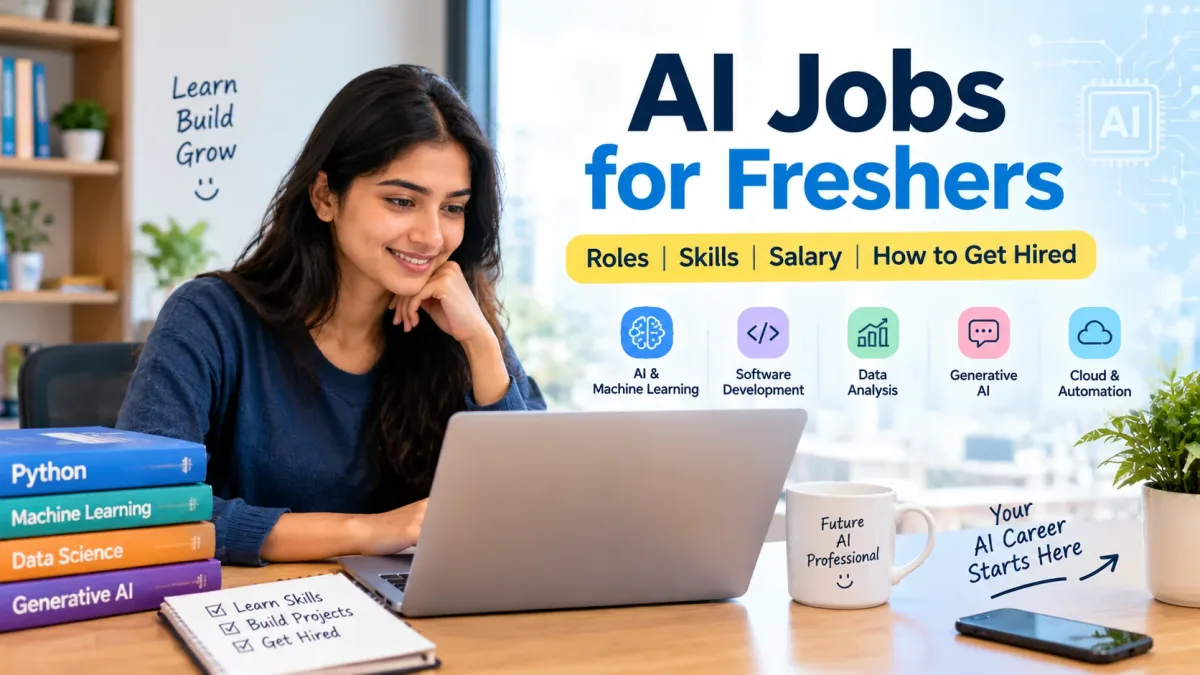
If you are a fresher looking at the job market right now, you have probably noticed one word appearing everywhere: AI.
Companies are hiring for artificial intelligence, machine learning, data, automation and generative AI roles. At the same time, students are seeing job posts asking for Python, machine learning, large language models, cloud platforms, data analysis and a long list of tools.
That can make the whole thing feel confusing.
Do you need a master's degree? Is Python enough? Can a BTech or BCA graduate get an AI job? Do you need to know ChatGPT, machine learning and deep learning before applying? And perhaps the biggest question of all: are there really AI jobs for freshers?
Yes, there are. But getting one is not simply about adding “AI” to your resume.
Employers want people who can understand a problem, work with data or software, build something useful and learn quickly. The good news is that you can start building those skills before you have your first full-time job.
This guide explains the AI jobs freshers can realistically target in 2026, the skills worth learning, salary expectations, project ideas and a practical roadmap for getting started.
Are There AI Jobs for Freshers?
Yes, but there is an important distinction between entry-level AI opportunities and highly specialized AI research roles.
A fresher is unlikely to walk into a company and immediately become the lead AI architect or research scientist. Those positions normally require substantial experience and deeper technical knowledge.
However, fresh graduates can target roles such as:
- Junior AI Engineer
- AI Developer
- Machine Learning Intern
- Junior Machine Learning Engineer
- Data Analyst
- AI/ML Trainee
- Generative AI Developer
- AI Automation Developer
- Junior Data Scientist
- AI Research Intern
- Python Developer with AI/ML skills
The exact job title varies from company to company. Two organizations may advertise almost the same work under completely different titles.
That is why searching for only “AI Fresher” can unnecessarily limit your options.
Why AI Jobs Are Growing
AI is no longer limited to technology companies or research laboratories. Businesses in finance, healthcare, retail, manufacturing, consulting, education, software and many other industries are exploring ways to use AI.
The World Economic Forum's Future of Jobs Report 2025 lists AI and big data among the fastest-growing skill areas through 2030. AI and machine learning specialists are also among the fastest-growing technology-related roles identified by employers.
That does not mean every company is hiring hundreds of AI engineers.
What it does mean is that AI is becoming part of a much larger range of jobs.
A software developer may use AI APIs. A data analyst may use machine learning models. A customer-service team may use an AI assistant. A marketing team may use generative AI. A business analyst may work on AI automation.
This creates an interesting opportunity for freshers: you do not necessarily have to become an AI researcher to build an AI-related career.
Best AI Jobs for Freshers in 2026
Here are some of the most useful entry-level career paths to consider.
1. AI/ML Engineer
An AI/ML Engineer works on applications that use machine learning or artificial intelligence.
Depending on the company, the role may involve preparing data, training models, testing algorithms, building APIs or deploying machine learning systems.
Useful skills:
- Python
- Machine learning fundamentals
- Statistics
- SQL
- Data preprocessing
- Scikit-learn
- Basic cloud knowledge
This is a good option for students who enjoy coding and are comfortable with mathematics and problem-solving.
2. AI Developer
AI Developer is a broader role that can involve building applications around existing AI models.
You may work with APIs, AI platforms, databases and backend systems rather than training a model from scratch.
This makes the role particularly interesting for software developers who want to move into AI.
Useful skills:
- Python or another programming language
- REST APIs
- Git and GitHub
- Databases
- LLM APIs
- Basic machine learning knowledge
- Application deployment
3. Generative AI Developer
Generative AI has created a new class of application-development opportunities.
GenAI developers may build chatbots, document assistants, content tools, AI search systems or internal business applications using large language models.
Freshers can start preparing for these roles by learning how LLM APIs work and then building small applications around them.
Useful skills:
- Python
- LLM APIs
- Prompt engineering
- RAG
- Embeddings
- Vector databases
- APIs
- Basic frontend or backend development
4. Machine Learning Intern
An internship can be one of the easiest ways for a fresher to get practical experience.
As an ML intern, you might work on data cleaning, exploratory analysis, model training, experimentation or documentation.
Do not underestimate internships simply because they are temporary. A good internship gives you something a course cannot: experience working with real requirements, messy data and deadlines.
5. Data Analyst
Data analysis is not exactly the same as artificial intelligence, but it can be an excellent entry point into the AI ecosystem.
Data analysts work with data to find patterns, create reports and support business decisions.
After gaining experience, some professionals move toward data science, machine learning or AI engineering.
Useful skills:
- SQL
- Excel
- Python
- Statistics
- Power BI or Tableau
- Data visualization
6. Junior Data Scientist
Data scientists use statistics, programming and machine learning to solve business problems using data.
Entry-level data science positions can be competitive, so freshers should have a solid understanding of statistics, Python, SQL and machine learning.
Projects matter a lot here because employers want to see that you understand the complete data-to-model process.
7. AI Automation Developer
AI is increasingly being used to automate repetitive business processes.
An AI automation developer might build workflows that classify emails, extract information from documents, summarize reports or connect AI systems with business software.
This role can suit people who enjoy practical problem-solving and software integration.
8. AI Research Intern
If you enjoy mathematics, algorithms and reading technical papers, an AI research internship may be worth exploring.
Research-oriented positions tend to have higher academic expectations than application-development roles.
Strong fundamentals in mathematics, statistics, machine learning and programming are useful, and postgraduate study may be preferred for some research paths.
AI Jobs for Freshers Without Experience
This is where many students get stuck.
Job descriptions ask for experience, but how are you supposed to get experience when you have never had a job?
The answer is to create evidence of your ability.
Your first evidence can come from:
- Academic projects
- Personal AI projects
- Internships
- Open-source contributions
- Hackathons
- Freelance work
- GitHub repositories
- Research projects
You do not need five years of professional experience to prove that you can build something.
Suppose you build a small AI application that allows users to upload a PDF and ask questions about it. That project can demonstrate programming, APIs, document processing, embeddings, retrieval and LLM integration.
It may not replace professional experience, but it gives an interviewer something concrete to discuss.
Skills Required for AI Jobs for Freshers
You do not need to learn every AI technology before applying for your first job.
In fact, trying to learn everything at once is one of the fastest ways to make no progress.
Start with the fundamentals.
1. Python
Python is one of the most useful languages for AI, machine learning and data work.
Learn functions, loops, data structures, classes, file handling, error handling and basic object-oriented programming.
Then start using libraries rather than spending months studying Python in isolation.
2. SQL
AI systems depend heavily on data, and SQL is still one of the most useful skills for working with that data.
Learn SELECT queries, filtering, joins, grouping, subqueries and basic window functions.
Even if your final goal is AI engineering, SQL can make you much more useful.
3. Statistics
You do not need to become a mathematician, but you should understand basic statistics.
Start with concepts such as:
- Mean, median and standard deviation
- Probability
- Distributions
- Correlation
- Sampling
- Hypothesis testing
Statistics becomes particularly important when you move into data science and machine learning.
4. Machine Learning Fundamentals
Learn what supervised and unsupervised learning mean and understand common algorithms such as linear regression, logistic regression, decision trees, random forests and clustering.
More importantly, understand when to use a particular approach and how to evaluate the result.
5. Generative AI
If you want to work in the current AI market, learn the basics of large language models and generative AI.
Understand tokens, prompts, context windows, embeddings, model APIs, hallucinations and evaluation.
You do not need to train a large language model from scratch to demonstrate GenAI skills.
6. Git and GitHub
Learn how to create repositories, commit code, write a useful README and work with branches.
Your GitHub profile can become a public portfolio of your technical work.
7. APIs
Modern AI applications often connect several services together.
Understanding REST APIs, JSON, authentication and basic backend development will help you build more realistic projects.
8. Communication
This skill is easy to overlook.
Imagine two candidates with similar technical ability. One can clearly explain what they built, why they chose a particular approach and what went wrong. The other struggles to explain their own project.
The first candidate is easier for an employer to trust.
AI careers need human skills too. The World Economic Forum's research highlights analytical thinking, creative thinking, resilience, flexibility and lifelong learning alongside technology skills.
Do Freshers Need a Degree for AI Jobs?
A degree can certainly help, especially when applying to structured graduate programs or research-heavy positions.
Common educational backgrounds include:
- BTech / BE
- BCA
- MCA
- BSc Computer Science
- BSc Data Science
- Statistics
- Mathematics
- Electronics and related engineering fields
But your degree is not the entire story.
For application-focused AI roles, practical skills can make a major difference. A candidate who understands Python, APIs, databases and AI applications and can demonstrate working projects may have a stronger interview conversation than someone who has only collected certificates.
For research positions, the requirements can be considerably more academic.
Best AI Projects for Freshers
If you are serious about getting an AI job, spend less time collecting random tutorials and more time building.
Here are some projects that can make a useful portfolio.
1. AI Resume Analyzer
Create an application that compares a resume with a job description and identifies relevant skills, missing keywords and areas for improvement.
This is a particularly useful project because it demonstrates a real-world use case.
2. PDF Question-Answering App
Allow users to upload documents and ask questions about their contents.
This project can demonstrate document processing, embeddings, retrieval and LLM integration.
3. AI Interview Practice Tool
Build an application that asks candidates interview questions and provides structured feedback on their answers.
4. Customer Support Assistant
Create a chatbot that answers questions from a company's knowledge base instead of simply generating generic responses.
5. Sales Data Prediction Project
Use a public dataset to build a machine learning model that predicts sales or another measurable business outcome.
Explain your data cleaning, feature selection, model choice and evaluation.
6. AI Document Summarizer
Build a tool that summarizes long documents and allows users to ask follow-up questions.
7. AI Automation Workflow
Connect an AI model with email, spreadsheets or another application to automate a repetitive task.
The goal is not to make the most complicated project possible.
The goal is to show that you can identify a problem and build a sensible solution.
What Should an AI Fresher Put on Their Resume?
Your resume should make it easy for a recruiter to understand what you can actually do.
Instead of writing:
“Knowledge of AI and machine learning.”
show the work behind that statement.
For example:
“Built a Python-based document Q&A application using an LLM API, embeddings and vector search to answer questions from uploaded PDF files.”
That sentence gives the recruiter something specific to evaluate.
For projects, try to mention:
- What problem you solved
- What technology you used
- What you personally built
- How the application worked
- Any measurable result
AI Jobs for Freshers Salary in India
Salary is one of the first things most freshers want to know, but there is no single salary figure for “AI jobs.”
Compensation varies according to the company, role, location, educational background, technical skills, interview performance and whether the position is truly AI-focused or simply includes some AI-related work.
A sensible way to think about the market is by role rather than by one headline number.
Role Typical Entry-Level Profile Skills That Can Improve Your Chances AI/ML Intern Student or recent graduate Python, ML basics, projects AI/ML Trainee Fresher Python, SQL, statistics, ML Junior AI Developer Fresher with programming skills Python, APIs, Git, AI tools Data Analyst Fresher with data skills SQL, Excel, Python, visualization GenAI Developer Fresher with AI application projects LLMs, APIs, RAG, PythonBe careful with social-media posts claiming that every AI fresher can immediately earn an extremely high package. Exceptional offers do exist, but they are not a realistic benchmark for everyone entering the field.
Your first job should be judged not only by salary but also by the quality of work, mentorship, learning opportunities and the experience you can build.
How to Get an AI Job as a Fresher
If you are starting today, you can follow a simple sequence instead of trying to learn everything simultaneously.
Step 1: Pick One Direction
Decide whether you are more interested in AI engineering, machine learning, data science, generative AI or AI automation.
You can change direction later. The purpose is simply to avoid learning five unrelated paths at the same time.
Step 2: Learn the Fundamentals
For a technical AI path, start with Python, SQL, basic statistics and programming fundamentals.
Step 3: Learn Machine Learning
Understand the basic algorithms, model evaluation and the machine-learning workflow.
Step 4: Add Generative AI
Learn how LLM APIs work and build a small application.
Step 5: Build 2–3 Strong Projects
Do not create 20 projects that all look like tutorials.
Build a few projects that you can explain confidently during an interview.
Step 6: Publish Your Work
Put your code on GitHub and create a simple portfolio if possible.
Include screenshots, a project description, technologies used and instructions for running the project.
Step 7: Apply for Internships Too
Do not search only for permanent “AI Engineer” positions.
Internships, trainee roles and junior software positions can be useful entry points.
Step 8: Prepare for Interviews
Be ready to explain your projects from beginning to end.
For AI/ML roles, prepare Python, SQL, statistics, machine learning fundamentals and basic system or deployment concepts depending on the position.
Step 9: Keep Applying
Your first application may not work.
Your tenth application may not work either.
That is normal.
Use every interview to identify what you could not answer, improve that area and try again.
Where Can Freshers Find AI Jobs?
Do not depend on a single job website.
Look across several channels:
- Company career pages
- Job portals
- College placement portals
- Startup job boards
- Internship platforms
- Hackathon communities
- GitHub and open-source communities
- Professional networking
On TechNaukary, you can also browse the latest AI jobs, fresher jobs and related technology opportunities as they become available.
AI Jobs Without Coding: Is It Possible?
Yes, but the answer needs some context.
Not every job connected to AI requires you to be an advanced programmer.
There are opportunities around AI operations, product management, content workflows, business analysis, AI adoption, governance, testing and automation.
However, if your goal is to become an AI engineer or machine learning engineer, programming is difficult to avoid.
You do not have to be an expert programmer before starting. But learning Python and basic software development will open considerably more doors.
Should Freshers Learn Generative AI or Machine Learning First?
If you are completely new to the field, learn the fundamentals first.
Understanding programming, data, statistics and basic machine learning gives you a foundation that will remain useful even as individual AI tools change.
Then add generative AI.
For someone who already knows software development, it can make sense to move into LLM APIs, RAG and AI application development relatively quickly.
There is no universal order for everyone.
The important thing is to avoid treating one AI tool as your entire career.
Common Mistakes Freshers Make While Looking for AI Jobs
1. Learning Everything at Once
Python, TensorFlow, PyTorch, LangChain, cloud, NLP, computer vision, LLMs, MLOps, data science...
The list can become endless.
Pick a direction and go deep enough to build something.
2. Collecting Certificates
Certificates can support your learning, but they cannot replace practical ability.
If you have to choose between another beginner course and building a useful project, the project may give you more to discuss during an interview.
3. Copying Projects
Following a tutorial is fine while learning.
But if your entire portfolio consists of projects you cannot explain, an interviewer will probably notice.
Change the project. Add a feature. Use a different dataset. Solve a different problem.
4. Ignoring SQL
Many beginners focus entirely on AI models and forget about data.
SQL remains an extremely useful skill for working with real-world data.
5. Ignoring Communication
You should be able to explain technical ideas in simple language.
An interviewer does not need you to sound complicated. They need to understand your thinking.
6. Applying Only to “AI Engineer” Jobs
This can dramatically reduce the number of opportunities you see.
Search for related roles such as ML Engineer, AI Developer, Data Analyst, Data Scientist, Python Developer, AI Automation Developer, GenAI Developer and ML Intern.
AI Jobs for Freshers: A Simple 6-Month Roadmap
If you have roughly six months to prepare, a focused roadmap could look like this:
Month Focus Month 1 Python, programming fundamentals and Git Month 2 SQL, statistics and data analysis Month 3 Machine learning fundamentals and first ML project Month 4 Generative AI, LLM APIs and prompt design Month 5 RAG, APIs and a practical AI application Month 6 Portfolio, resume, interview preparation and job applicationsYou do not have to follow this exact schedule.
If you already know Python, move faster. If statistics is your weak area, spend more time there.
The roadmap is a framework, not a rule.
What Do Companies Actually Want From AI Freshers?
This is perhaps the most important question.
Companies do not expect every fresher to know everything.
They are usually looking for signs that a candidate can learn, solve problems and work with technology.
A strong entry-level candidate might demonstrate:
- Good programming fundamentals
- Basic understanding of AI and machine learning
- Ability to work with data
- One or more practical projects
- Good problem-solving ability
- Clear communication
- Curiosity and willingness to learn
- Ability to explain their own work
This matters because AI itself is changing quickly.
The specific framework you learn today may not be the framework a company uses two years from now. The ability to learn and adapt is therefore valuable.
Future of AI Jobs for Freshers
The AI job market will probably look different five years from now than it does today.
Some tasks will become automated. Some existing jobs will change. New roles will appear.
The World Economic Forum expects AI and big data to be among the fastest-growing skill areas through 2030, while also emphasizing human capabilities such as analytical thinking, creative thinking, resilience and lifelong learning.
That combination gives us an important clue about the future.
Learning AI alone may not be enough.
The stronger career strategy is to combine AI with something else.
AI + software development.
AI + data.
AI + finance.
AI + healthcare.
AI + marketing.
AI + cybersecurity.
AI + business knowledge.
Domain knowledge gives you context. AI gives you another set of tools for solving problems.
Final Thoughts
Getting your first AI job as a fresher is possible, but it is not a shortcut career.
You do not need to know every AI tool. You do not need to build your own ChatGPT. And you definitely do not need to believe every viral salary screenshot on social media.
Start with the basics.
Learn Python. Understand data. Learn SQL. Study machine learning. Explore generative AI. Build projects. Put those projects on GitHub. Improve your resume. Practice interviews. Apply consistently.
Most importantly, learn to solve problems rather than simply collect technologies.
The fresher who can confidently say, “Here is the problem I found, here is what I built, here is why I chose this approach, and here is what I learned when it didn't work,” already has something valuable to bring to an interview.
Your first AI job does not have to be your dream job.
It just needs to be a good first step.
Frequently Asked Questions About AI Jobs for Freshers
Can freshers get AI jobs in 2026?
Yes. Freshers can apply for entry-level AI, machine learning, data and generative AI roles. Internships, trainee positions and junior developer roles can also provide an entry point into the field.
Which AI job is best for freshers?
There is no single best AI job for everyone. AI Developer, Junior AI/ML Engineer, ML Intern, Data Analyst, GenAI Developer and AI Automation Developer can all be possible starting points depending on your skills.
What should I learn for AI jobs as a fresher?
Start with Python, SQL, basic statistics, machine learning fundamentals and Git. Then add generative AI, APIs, RAG or another specialization based on the role you want.
Can I get an AI job without experience?
Yes. While professional experience can help, freshers can demonstrate their ability through internships, academic projects, personal projects, GitHub repositories, hackathons and open-source contributions.
Can BCA students get AI jobs?
Yes. BCA graduates can pursue AI-related roles, particularly application development, data, automation and entry-level AI/ML positions. Building strong programming, data and AI skills can improve their opportunities.
Can I get an AI job without coding?
Some AI-related roles do not require advanced coding, but technical AI engineering and machine learning roles generally require programming. Learning basic Python can significantly increase the number of AI opportunities available to you.
Is Python enough for an AI job?
Python is an excellent starting point, but it is rarely enough by itself. Depending on the role, you may also need SQL, statistics, machine learning, APIs, cloud skills, data handling or generative AI knowledge.
Do AI freshers need certifications?
Certifications can support your learning, but they are not a substitute for practical skills. Projects, internships and the ability to explain what you built can be more useful during technical interviews.
How can I get an AI internship as a fresher?
Build one or two relevant projects, create a clear resume, maintain a GitHub portfolio and apply regularly to internships, startups, research groups and company graduate programs. Networking and college placement opportunities can also help.
What is the salary of an AI fresher in India?
There is no fixed salary because compensation varies significantly by company, role, location and candidate skills. Instead of focusing on one promised number, compare the role, learning opportunities, responsibilities and overall career growth.