Gen AI Jobs 2026: Skills, Roles, Salary & Career Guide
Gen AI jobs are moving beyond traditional machine learning roles, creating opportunities in AI engineering, AI agents, RAG, automation, AI product development and more. Learn which skills companies want and how to build a career in generative AI.
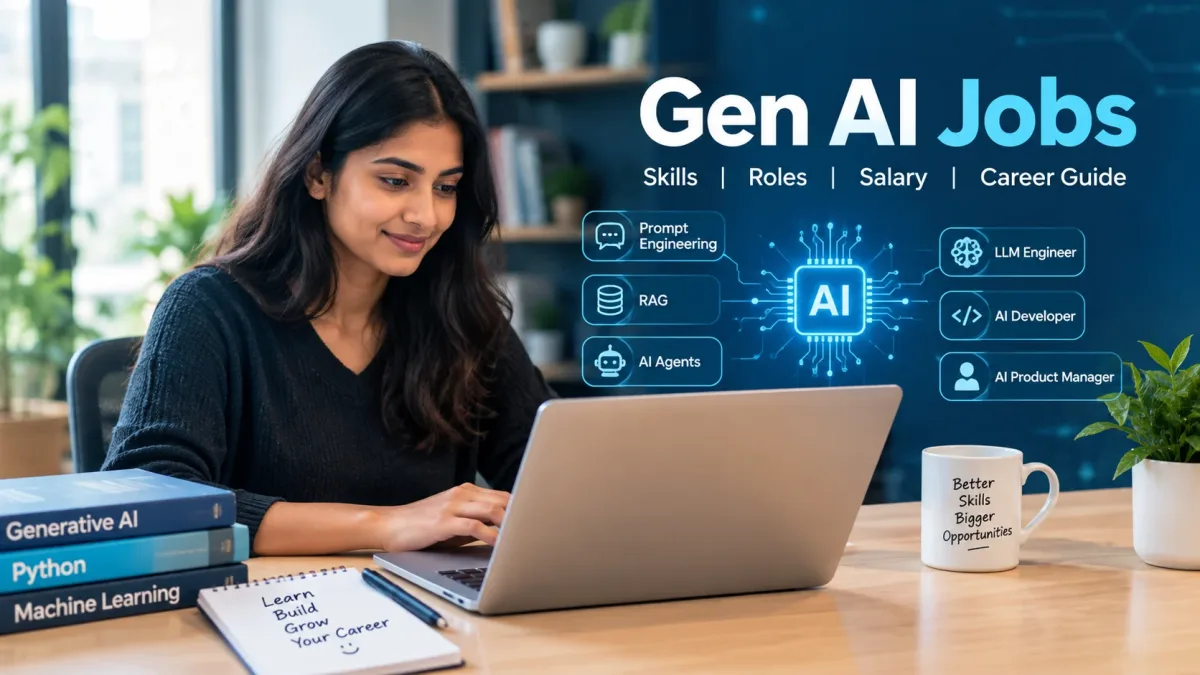
Generative AI has moved from being an interesting technology experiment to something companies are actively building into their products, services and everyday workflows. That shift is creating a new category of career opportunities for developers, data professionals, designers, analysts, product specialists and even people who are not traditional programmers.
If you are searching for Gen AI jobs in 2026, there is one important thing to understand: the market is changing quickly. Companies are not only looking for people who know how to train AI models. They also need professionals who can connect AI models with real business problems and turn them into useful products and workflows.
That includes building AI agents, integrating large language models, developing RAG applications, creating AI-powered automation, evaluating model output, managing AI systems and helping organizations adopt generative AI safely.
This guide explains the major Gen AI career opportunities, the skills employers are looking for, salary expectations, entry-level options and a practical roadmap for getting started.
What Are Gen AI Jobs?
Gen AI jobs are roles that involve developing, deploying, integrating, managing or using generative artificial intelligence systems.
Generative AI refers to AI systems that can create new content such as text, code, images, audio, video and other forms of data. Large language models such as GPT-based systems are one of the best-known examples.
However, a Gen AI career is not limited to writing prompts or using an AI chatbot.
A professional working in this field may build an AI assistant for a company, connect an LLM to a private knowledge base, develop an AI agent that performs tasks, evaluate model responses, create an AI-powered customer support system or integrate generative AI into an existing application.
In simple terms, the opportunity is becoming less about simply knowing AI and more about knowing how to make AI useful.
Why Are Gen AI Jobs Growing?
The rapid adoption of AI is one of the biggest reasons demand for AI-related skills is increasing.
The World Economic Forum's Future of Jobs Report 2025 identifies AI and big data as the fastest-growing skill area through 2030. AI and machine learning specialists are also among the fastest-growing technology roles. The report surveyed more than 1,000 employers representing over 14 million workers worldwide.
At the same time, businesses are moving from AI experimentation toward practical implementation. Instead of asking, “Can we use AI?”, companies increasingly want to know, “How can we use AI to reduce costs, improve productivity, build a product or create a better customer experience?”
That change is opening opportunities for people who can bridge the gap between AI technology and business requirements.
Recent hiring trends in India also show this shift. AI recruitment is expanding into areas such as AI agents, GenAI engineering, AI architecture, AgentOps, AI governance, evaluation and enterprise AI integration.
Top Gen AI Jobs in 2026
There is no single “Gen AI job.” The industry includes several different career paths, and the right one depends on your background and interests.
1. Generative AI Engineer
A Generative AI Engineer develops applications powered by large language models and other generative AI systems.
The work may include integrating model APIs, building AI-powered applications, creating RAG pipelines, working with vector databases and deploying AI solutions to production.
Common skills:
- Python
- LLM APIs
- Prompt engineering
- RAG
- Vector databases
- APIs and backend development
- Cloud platforms
- AI application development
2. AI/ML Engineer
AI/ML Engineers work on machine learning systems and increasingly incorporate generative AI capabilities into applications.
This can be a good career path for people who enjoy mathematics, programming, data and machine learning concepts.
Depending on the organization, the role can involve model development, fine-tuning, inference optimization, evaluation and deployment.
3. LLM Engineer
LLM Engineers specialize in applications built around large language models.
They may work with model APIs, open-source models, retrieval systems, prompt pipelines, fine-tuning and evaluation frameworks.
A strong LLM Engineer understands that producing a good AI application requires more than sending a prompt to a model. Data quality, context, retrieval, evaluation, latency, cost and security all matter.
4. AI Agent Developer
AI agents are becoming an important part of the next generation of AI applications.
Instead of simply responding to a question, an AI agent can potentially reason through a task, use tools, interact with software and complete multiple steps.
AI Agent Developers may work with agent frameworks, APIs, tool calling, workflow orchestration and enterprise systems.
This is one of the areas worth watching if you are planning a GenAI career in 2026.
5. RAG Engineer
Retrieval-Augmented Generation, commonly called RAG, allows an AI application to retrieve relevant information from external sources before generating an answer.
RAG is particularly useful for businesses because companies often want AI systems to work with their own documents, databases and internal knowledge.
A RAG Engineer may work with document processing, embeddings, vector databases, retrieval systems, LLMs and evaluation.
6. AI Solutions Architect
AI Solutions Architects focus on designing how AI systems fit into larger technology environments.
They may decide which models and services should be used, how data should flow through the system, how security should be handled and how the solution can scale.
This is generally a more experienced career path and requires strong knowledge of software architecture, cloud technology and AI systems.
7. AI Product Manager
Not every Gen AI career requires deep programming skills.
AI Product Managers work between business teams, customers, designers and technical teams to identify useful AI applications and turn them into products.
They need to understand AI capabilities and limitations while also thinking about customer needs, product strategy, usability and business outcomes.
8. AI Evaluation and Quality Specialist
AI systems can produce incorrect, inconsistent or unsafe responses. This makes evaluation an increasingly important part of AI development.
AI evaluation professionals design tests, measure model performance, identify failure patterns and help teams improve AI systems.
This area can be particularly interesting for people who enjoy analytical work, testing and quality assurance.
9. AI Governance and AI Safety Specialist
Organizations need policies and controls around how AI systems are developed and used.
AI governance roles can involve responsible AI practices, privacy, security, risk management, compliance, model oversight and internal AI policies.
These roles are especially relevant in industries where data privacy and regulatory requirements are important.
10. AI Automation Specialist
AI Automation Specialists help businesses automate repetitive processes using AI tools and software integrations.
For example, an organization might use AI to classify customer emails, summarize documents, extract information from files or automate parts of an internal workflow.
This career path can be attractive to professionals who understand business processes and want to combine them with modern AI tools.
Gen AI Jobs for Freshers
One of the most common questions students ask is whether Gen AI jobs are available for freshers.
The answer is yes, but the competition can be strong.
Companies generally do not hire someone simply because they completed an AI course or collected certificates. They want evidence that the candidate can actually build or use technology to solve a problem.
For a fresher, a strong portfolio can therefore make a significant difference.
Instead of creating ten small tutorial projects, build two or three projects that demonstrate useful skills.
For example:
- An AI chatbot that answers questions from uploaded documents
- A RAG-based knowledge assistant
- An AI-powered resume analysis application
- An AI customer-support assistant
- An AI research assistant
- An AI agent that uses external tools
- An AI automation workflow
Document what you built, why you built it, what technologies you used and what problems you faced.
A working project with a clear explanation is usually more convincing than a resume filled with buzzwords.
Skills Required for Gen AI Jobs
The exact requirements vary by role, but several skills appear repeatedly across GenAI positions.
1. Python
Python remains one of the most useful programming languages for AI and machine learning.
You do not need to become a Python expert on day one, but you should be comfortable with variables, functions, classes, APIs, data structures, libraries and writing small applications.
2. Large Language Models
Understand what LLMs are, how they work at a high level and what their strengths and limitations are.
You should become familiar with concepts such as tokens, context windows, inference, embeddings, temperature, model selection and evaluation.
3. Prompt Engineering
Prompt engineering is useful, but it should not be treated as the entire GenAI career.
Good prompting involves clearly defining the task, providing useful context, specifying constraints and designing outputs that can be evaluated.
4. RAG
RAG is one of the most practical concepts for enterprise AI applications.
Learn how documents are processed, converted into embeddings, stored, retrieved and supplied as context to an LLM.
5. APIs
Modern AI applications often connect several services together.
Understanding REST APIs, authentication, JSON, webhooks and basic backend development can therefore be extremely valuable.
6. Vector Databases
Vector databases are commonly used in applications that need semantic search and retrieval.
Understanding embeddings and similarity search will help you build more capable RAG applications.
7. Cloud and Deployment
Building an AI project on your laptop is only the beginning.
Learn the basics of deploying applications using cloud platforms, containers, environment variables, logging and monitoring.
8. AI Evaluation
One of the biggest mistakes beginners make is assuming that an AI application is successful simply because it produces an answer.
Professional AI systems need evaluation.
Learn how to create test datasets, measure accuracy or task success, identify hallucinations and compare different prompts or models.
9. Problem-Solving
This is arguably more important than knowing a particular framework.
Companies need people who can look at a real problem and decide whether AI is actually the right solution.
That requires analytical thinking, experimentation and good judgment.
10. Communication
AI projects are rarely built by one person working in isolation.
You may need to explain technical decisions to managers, understand requirements from customers or work with developers, designers and data teams.
Strong communication can therefore make a technical candidate considerably more effective.
Gen AI Jobs Salary in India
Salary for Gen AI jobs varies significantly depending on experience, technical depth, company, location, role and the ability to work on production systems.
It is therefore better to think in terms of career stages rather than expecting one fixed salary figure.
Career Stage Typical GenAI Roles What Employers Usually Look For Entry Level AI Developer, Junior AI Engineer, AI Automation Developer Programming fundamentals, AI APIs, projects and problem-solving Mid Level GenAI Engineer, LLM Engineer, RAG Engineer Production experience, system design, deployment and evaluation Senior Level AI Architect, AI Lead, Senior GenAI Engineer Architecture, leadership, scalability, security and business impactSalary data should be treated as a market estimate rather than a promise. AI skills can command a premium, but employers increasingly care about demonstrated ability rather than certificates alone.
For example, recent reporting based on PwC's 2026 Global AI Jobs Barometer indicates that AI-skilled workers can receive substantial wage premiums, with the effect particularly visible when AI expertise is combined with existing professional or domain knowledge.
How to Get a Gen AI Job as a Fresher
If you are starting from zero, you do not need to learn everything about artificial intelligence before applying for your first job.
Instead, follow a focused learning path.
Step 1: Learn Programming Fundamentals
Start with Python if you do not already know a programming language.
Focus on practical programming rather than trying to memorize the entire language.
Step 2: Understand Generative AI
Learn the basics of LLMs, embeddings, tokens, prompts, APIs and model limitations.
Step 3: Build Your First AI Application
Use an LLM API to build something simple.
For example, create a document summarizer or question-answering application.
Step 4: Learn RAG
Build a project that can answer questions using a collection of documents.
This will teach you several important concepts at once, including embeddings, retrieval and context management.
Step 5: Explore AI Agents
Once you understand basic LLM applications, experiment with tool calling and agent-style workflows.
Step 6: Put Projects on GitHub
Your GitHub profile should show what you can actually build.
For every project, include a short README explaining the problem, architecture, technologies used and how someone can run the project.
Step 7: Build a Strong Resume
Do not simply write “Knowledge of Generative AI.”
Show measurable or concrete work.
For example, instead of:
“Worked on an AI project.”
write:
“Built a RAG-based document assistant using Python, an LLM API and vector search to answer questions from a custom knowledge base.”
Step 8: Apply Consistently
Search for several related job titles instead of searching only for “Gen AI Engineer.”
Try terms such as:
- Generative AI Engineer
- GenAI Developer
- LLM Engineer
- AI Engineer
- AI Developer
- RAG Engineer
- AI Agent Developer
- Machine Learning Engineer
- AI Automation Developer
- AI Solutions Engineer
Do You Need a Degree for Gen AI Jobs?
A degree can help, especially for research-heavy AI and machine learning positions, but it is not the only way into the industry.
For application-focused GenAI roles, practical skills can be extremely valuable.
A candidate who can demonstrate strong programming, useful projects, API integration, RAG, deployment and problem-solving may have a stronger profile than someone who has completed several courses but cannot build a working application.
For research positions, however, advanced mathematics, machine learning knowledge and often a postgraduate degree can become much more important.
Are Gen AI Jobs Only for Programmers?
No.
Programming is important for many technical roles, but generative AI is creating opportunities across multiple disciplines.
Professionals in marketing, finance, HR, sales, operations, design, content, consulting and customer service can also specialize in AI-enabled workflows.
For example, someone with strong finance knowledge can become valuable by understanding how AI can be applied to financial analysis and reporting. A marketing professional can specialize in AI-powered content workflows and campaign analysis.
The strongest combination is often domain knowledge + AI skills.
Gen AI vs Traditional AI Jobs
Traditional AI and machine learning roles are still extremely important.
The difference is mainly in the type of systems being built.
Traditional AI/ML Generative AI Prediction and classification Content generation and reasoning-style applications Structured datasets are common Unstructured text, documents and multimedia are common Machine learning models LLMs and generative models Feature engineering Prompting, retrieval and context engineering Model training and prediction Model integration and application development ML pipelines LLM pipelines, RAG and agent workflowsThere is considerable overlap between the two fields. A strong foundation in machine learning can make it easier to understand advanced GenAI systems.
Is Prompt Engineering Still a Good Career?
Prompt engineering is useful, but treating it as a standalone career plan can be risky.
Companies increasingly want professionals who can do more than write good prompts.
They need people who can connect models to data, build reliable workflows, evaluate responses, integrate APIs and deploy applications.
Therefore, instead of learning only prompt engineering, consider learning prompting + programming + RAG + APIs + evaluation.
That combination gives you a much stronger foundation.
Best Gen AI Projects for Your Resume
If your goal is to get hired, your projects should demonstrate real skills.
Here are some ideas:
- Resume Analyzer: Build an application that compares a resume with a job description and identifies missing skills.
- Document Q&A Assistant: Create a RAG application that answers questions from uploaded documents.
- AI Interview Coach: Build an assistant that asks interview questions and provides structured feedback.
- Customer Support Agent: Create an AI assistant that retrieves information from a knowledge base and responds to customer questions.
- Research Assistant: Build a tool that organizes information and produces structured research summaries.
- AI Automation Workflow: Connect an AI model with email, spreadsheets or other business tools to automate a repetitive process.
The best project is not necessarily the most complicated one. A simple application that solves a real problem and is well documented can be more impressive than a complicated project copied from a tutorial.
Common Mistakes When Preparing for Gen AI Jobs
Learning Too Many Tools
Frameworks change quickly. Do not spend all your time memorizing libraries.
Understand the underlying concepts so you can adapt when tools change.
Collecting Certificates Instead of Building Projects
Courses can help you learn, but certificates alone do not demonstrate that you can solve a real problem.
Ignoring Software Engineering
A GenAI application still needs clean code, authentication, error handling, testing, security and deployment.
Believing Every AI Output
LLMs can make mistakes. Learning how to evaluate and verify AI output is an essential professional skill.
Ignoring Cost and Performance
A prototype that works is not automatically a production-ready application.
Real systems need to consider model cost, response time, scalability, reliability and user experience.
Future of Gen AI Jobs
The future of GenAI employment is unlikely to be as simple as “AI will replace jobs.” A more realistic picture is that AI will change the tasks people perform and create demand for professionals who know how to work effectively with these systems.
The World Economic Forum expects AI and big data to remain among the fastest-growing skill areas through 2030. It also highlights creative thinking, analytical thinking, resilience, flexibility and lifelong learning as increasingly important skills.
This combination is important.
The professionals who benefit most from AI may not be those who know the most AI terminology. They may be the people who can combine technical knowledge with judgment, communication and a deep understanding of the problem they are solving.
In India, the direction of hiring is also increasingly focused on implementation. Companies need people who can take AI from a demonstration to a reliable system that works inside an actual business.
Final Thoughts
Gen AI is creating a wide range of career opportunities, but the field is changing too quickly for a single fixed career formula.
If you are a student or fresher, start with programming fundamentals, learn how modern AI applications work and build practical projects.
If you are already a developer, add LLMs, RAG, AI agents, evaluation and deployment to your existing skills.
If you are a professional from another field, learn how generative AI can improve the work you already understand.
And most importantly, don't chase every new AI tool that appears on social media.
Build the fundamentals. Build real projects. Learn how to solve problems. Keep improving.
That is a much more sustainable way to build a career in GenAI than simply adding “AI expert” to your resume.
Frequently Asked Questions About Gen AI Jobs
What are Gen AI jobs?
Gen AI jobs are careers involving the development, deployment, integration, evaluation or practical use of generative artificial intelligence systems. They include GenAI engineers, LLM engineers, AI developers, AI architects, AI product managers and AI automation specialists.
Can freshers get Gen AI jobs?
Yes. Freshers can target entry-level AI and GenAI roles, particularly if they have strong programming fundamentals and practical projects. A portfolio demonstrating real AI applications can significantly strengthen a fresher's profile.
What skills are required for Gen AI jobs?
Common skills include Python, LLM APIs, prompt engineering, RAG, embeddings, vector databases, APIs, cloud deployment, AI evaluation and basic software engineering. Communication and problem-solving skills are also important.
Is Gen AI a good career in 2026?
GenAI is a promising career area because businesses across industries are investing in AI applications and automation. However, the strongest career prospects are likely to be for professionals who combine AI knowledge with software engineering, domain expertise or business understanding.
Can I get a Gen AI job without coding?
Some AI-related roles do not require advanced programming, including AI product, operations, governance and certain automation roles. However, learning basic programming can significantly expand the number of opportunities available to you.
Is prompt engineering enough to get a Gen AI job?
Prompt engineering is useful, but relying on prompting alone can limit your career options. Learning programming, APIs, RAG, evaluation and AI application development provides a much stronger foundation.
What is the best Gen AI job for freshers?
There is no single best role for everyone. AI developer, junior AI engineer, GenAI developer and AI automation roles can be good starting points for candidates with programming skills. Candidates should choose a role based on their strengths and career goals.