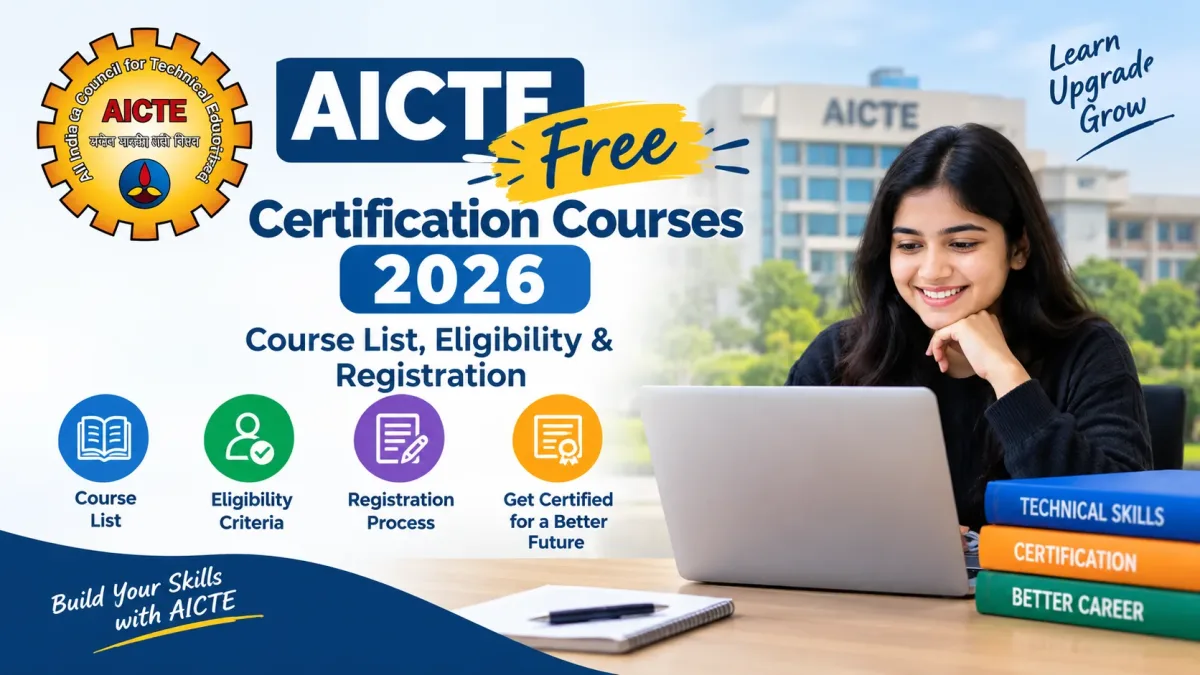
AICTE Free Certification Courses 2026: Course List, Eligibility & Registration
Looking for free online certificates to strengthen your resume? Explore AICTE-listed courses in programming, AI, data science, cybersecurity and web development, with eligibility details and step-by-step registration guidance for 2026.
For many college students, learning a new skill is easier said than done. Classes, assignments and exam preparation already take up a large part of the day, while paid certification courses can be difficult to afford. Yet employers often look for candidates who can demonstrate practical knowledge beyond their academic qualifications.
This is where AICTE-listed free learning opportunities can be useful. Students can explore courses in programming, artificial intelligence, data science, cybersecurity, web development and several other fields without necessarily spending money on course access.
If you are searching for AICTE free certification courses 2026, this guide covers popular course options, eligibility requirements, registration steps, certificate details and the official websites you should use. It also explains how to choose a course that adds genuine value to your resume.
What Are AICTE Free Certification Courses?
The All India Council for Technical Education (AICTE) is a statutory body under the Ministry of Education, Government of India, that is responsible for coordinated development and quality-related aspects of technical education in India.
AICTE has maintained an online resource portal listing free learning opportunities from different organisations and educational technology providers. These opportunities have included courses covering programming, cloud technologies, data analytics, cybersecurity, business skills and other subjects.
It is important to understand that AICTE-listed courses are not necessarily all created or directly taught by AICTE. Some are offered by external learning providers. The terms, availability, assessment requirements and certificates depend on the individual provider and course.
Students should also distinguish between a certificate of completion from a learning platform and a formal academic qualification. A short online certificate can demonstrate initiative and foundational knowledge, but it does not replace a degree or guarantee a job.
Official course portal: https://free.aicte-india.org/
AICTE Free Certification Courses 2026: Course List
The AICTE free-course directory has listed learning opportunities in several technical and non-technical areas. The following examples can help you decide which subjects to explore. Before enrolling, open the individual course page to confirm that the course is currently accessible and that its advertised certificate terms still apply.
1. Artificial Intelligence and Machine Learning
Artificial intelligence and machine learning are relevant to students interested in intelligent applications, predictive models and data-driven systems. These subjects can also provide a foundation for more advanced technical learning.
Examples listed in the AICTE free-course directory include:
- Machine Learning Foundations
- Machine Learning Foundations in R
- Artificial Intelligence with Python
- Deep Learning with Python
- Computer Vision Essentials
- Reinforcement Learning with Python
These courses may help learners understand machine learning concepts, explore Python-based implementations and become familiar with selected AI techniques. Students should check the prerequisites before choosing an advanced topic.
2. Python and Programming
Programming is a useful starting point for students pursuing computer science, information technology and related careers. Even learners from other backgrounds can benefit from understanding basic programming concepts.
Courses listed in the directory have included:
- Introduction to Programming
- Introduction to Python
- Java Programming
- Data Structures in C
- Data Structures and Algorithms in Java
- Introduction to R
Beginners should start with programming fundamentals, variables, conditions, loops and functions before moving to data structures or advanced algorithms. Practising small coding problems alongside the course will help reinforce what you learn.
3. Data Science and Data Analytics
Data-related skills are useful in software development, business analysis, research and many other professional fields. Learners who enjoy working with numbers, patterns and information may find these subjects interesting.
Examples of listed courses include:
- Data Science Foundations
- Basics of Exploratory Data Analysis
- Data Visualization using Python
- Statistics for Machine Learning
- Advanced Statistics for Machine Learning
- Linear Regression with Python
- Time Series Analysis in R
These subjects can introduce learners to data exploration, statistical reasoning, visualisation and analytical techniques. For a stronger portfolio, try applying the concepts to a small project using a publicly available dataset.
4. Web Development
Students interested in building websites and web applications can explore introductory front-end and full-stack development topics. These skills are particularly useful when combined with hands-on practice.
Relevant examples include:
- Introduction to Full Stack Development
- Front End Development - HTML
- Front End Development - CSS
After completing a beginner course, create a personal portfolio, a responsive landing page or a small interactive application. A working project gives recruiters a clearer picture of your abilities than a certificate alone.
5. Cybersecurity and Information Security
Cybersecurity focuses on protecting systems, networks, applications and information from unauthorised access and other threats. Students who are curious about computer networks and digital safety may want to explore this area.
Examples listed in the directory include:
- Introduction to Cyber Security
- Introduction to Ethical Hacking
- Introduction to Information Security
Begin with security fundamentals before moving to specialised topics. Always practise cybersecurity techniques in authorised learning environments and never test systems without permission.
6. Cloud Computing and Big Data
Cloud platforms and data-processing technologies are widely used in modern software systems. Learning the basics can help students understand how applications are deployed and how large amounts of information are processed.
Examples available in the directory have included Microsoft Azure Essentials, Getting Started with Hadoop, and Spark Basics and Streaming.
Availability may differ between courses, so review the provider's current page before planning your learning schedule.
7. Business, Marketing and Communication
Technical knowledge is important, but professional communication and business awareness also matter when applying for internships and jobs. Non-technical learners can explore these subjects to improve their workplace readiness.
Examples listed in the directory include:
- Content Marketing Basics
- Instagram Marketing Fundamentals
- Marketing and Retail Analytics
- Marketing: Strategic Framework
- Smart English Basics for Professionals
- Quantitative Aptitude Basics
These topics may help learners build familiarity with marketing concepts, professional communication and basic analytical skills.
Course catalogue: Browse the AICTE free-course directory.
Are These AICTE Courses Really Free?
Some courses listed in the AICTE free-course directory have been advertised as free, with certificates of completion available after the required assessment. However, free access should not automatically be interpreted as a guarantee that every course, certificate or related service is free in 2026.
Before starting a course, confirm the following:
- Whether the course can currently be accessed without payment.
- Whether the certificate is included or requires a separate fee.
- Whether you must complete quizzes, assignments or a final assessment.
- Whether the course is self-paced or has a fixed schedule.
- Whether the learning provider has additional conditions.
The AICTE resource portal also notes that the content of external providers is not necessarily vetted by AICTE and that the respective company is responsible for its content. Students should therefore review the provider's information rather than assume that every listing represents an AICTE-issued qualification.
Eligibility Criteria for AICTE Free Certification Courses 2026
There is no single eligibility rule that applies to every course in the directory. Requirements vary according to the subject, provider and learning programme.
In general, the following points can help you determine whether a course is suitable:
- College students: Many introductory courses are suitable for learners who want to develop additional skills alongside their studies.
- Engineering students: Programming, cloud computing, AI, data science and cybersecurity are possible areas to explore.
- Students from non-technical backgrounds: Introductory programming, communication, marketing and aptitude courses may be appropriate, depending on the stated prerequisites.
- Working professionals: Some courses may be suitable for people looking to update their knowledge or learn a new subject.
- Beginners: Courses that state no prior knowledge is required can be a useful starting point.
Do not assume that every course is restricted to AICTE-approved college students or that every course accepts all applicants. Read the eligibility and prerequisite details on the relevant course page.
How to Register for AICTE Free Certification Courses 2026
The registration process depends on the course and the learning provider. Follow these general steps to find and start a suitable course through the official resource portal.
Step 1: Visit the official AICTE free-course portal
Open free.aicte-india.org in your browser. Check that the address is correct before entering any personal information.
Step 2: Browse the available course categories
Explore the listed courses and identify the subject that matches your interests. You can begin with programming, AI, data science, cybersecurity, web development, cloud computing or communication skills.
Step 3: Open your chosen course
Select a course to read its description. Check the topics covered, prerequisites, learning format and technical requirements. This step can help you avoid enrolling in a course that is too advanced for your current level.
Step 4: Check the learning provider's terms
Look for the provider's enrolment instructions, fee information and certificate conditions. Some listings direct learners to an external platform, so you may need to complete registration there.
Step 5: Create an account if required
Follow the instructions on the course provider's website. Depending on the platform, you may need an email address, a password and basic profile information. Use accurate details so that your course records are correct.
Step 6: Enrol in the course
Choose the appropriate enrolment option and complete the steps displayed on the provider's website. If a course is no longer available, check whether an alternative course covers the same subject.
Step 7: Complete the learning modules
Study the material, complete the required lessons and attempt any quizzes or assignments. Make time for practical exercises instead of rushing through the content only to obtain a certificate.
Step 8: Check your certificate eligibility
After completing the required work, follow the provider's instructions for obtaining the certificate, if one is offered. Check that your name and course details are correct before adding the credential to your resume.
How to Download Your Course Certificate
Certificate availability and download procedures vary by provider. If your course includes a certificate, follow these general steps:
- Log in to the learning platform where you completed the course.
- Open your dashboard, completed courses or achievements section.
- Check whether all lessons and assessments have been completed.
- Open the certificate option if the course provides one.
- Download the certificate or follow the provider's instructions for accessing it.
- Save a copy and verify that your name and course title are correct.
If a certificate does not appear, review the completion requirements and contact the learning provider through its official support channel. Do not pay an unknown intermediary who promises to issue a certificate.
How AICTE Free Courses Can Help Your Resume
A short course can demonstrate that you have taken the initiative to learn something beyond your regular syllabus. However, the real value comes from understanding the subject and being able to apply it.
For example, a computer science student who completes an introductory Python course could build a small data-analysis project. A learner studying web development could publish a responsive portfolio website. Someone interested in cybersecurity could document a beginner-level project completed in a safe, authorised environment.
When adding a course to your resume, mention the course title, provider, completion date and relevant skills. Include a project link where possible, and describe only the skills you can explain confidently during an interview.
For more career guidance, explore relevant internship and job-preparation articles on TechNaukary.
Important Things to Remember Before Enrolling
- Use the official AICTE course directory and the provider's legitimate website.
- Verify that the course is available in 2026 rather than relying on an old course list or announcement.
- Check whether the course and certificate are free.
- Read the prerequisites, duration and assessment requirements.
- Do not confuse a provider-issued completion certificate with a formal academic qualification.
- Avoid websites promising guaranteed jobs or placements in exchange for an unexplained payment.
- Choose courses that support your actual career goals instead of collecting certificates without learning the material.
Frequently Asked Questions (FAQs)
1. Where can I find AICTE free certification courses in 2026?
You can begin with the AICTE free-course directory at free.aicte-india.org. Open individual listings to check their current availability and enrolment instructions.
2. Which subjects are available in AICTE-listed free courses?
The directory has included subjects such as Python, Java, machine learning, data science, web development, cybersecurity, cloud computing, marketing and professional communication. The active selection can change over time.
3. Are AICTE free courses available to all students?
Eligibility depends on the course and its provider. Some introductory courses accept learners from different backgrounds, while others have specific prerequisites or restrictions.
4. Do these courses provide free certificates?
Some listings advertise certificates of completion after learners satisfy the course requirements. Check the current terms to confirm whether the certificate is included at no cost.
5. Can first-year engineering students enrol?
First-year students can explore introductory courses if they meet the stated requirements. Programming fundamentals, Python basics and introductory web development may be useful starting points.
6. Is there one registration deadline for all AICTE free courses?
No single deadline applies to every course in the directory. Each provider or programme may have its own enrolment schedule, so check the relevant course page.
7. Can I add an AICTE-listed course certificate to my resume?
Yes, if you have genuinely completed the course and the certificate is validly issued by the provider. Include the provider's name and focus on the skills you gained. A certificate does not guarantee employment.
8. Does completing a free course guarantee an internship or job?
No. Courses can help you develop knowledge, but internships and jobs have separate selection processes. Projects, practical skills, communication and interview preparation remain important.
Final Thoughts and Key Takeaways
AICTE-listed free certification courses can be a useful starting point for students who want to learn new skills without committing to an expensive training programme. From programming and web development to artificial intelligence, data analytics and cybersecurity, the course directory has offered a variety of subjects for different interests and career goals.
If you are exploring AICTE free certification courses in 2026, start by choosing one subject that matches your current level. Verify that the course is still available, check its eligibility and certificate conditions, and follow the instructions on the official portal or learning provider's website.
Most importantly, focus on learning rather than simply collecting certificates. Complete the course, practise what you learn and build a small project that demonstrates your knowledge. That combination can help you make better use of online learning when preparing for internships, placements or your next career opportunity.
Official resource: AICTE Free Courses Portal
```