Agentic AI Roadmap 2026: Learn AI Agents Step by Step
Want to learn Agentic AI but don't know where to start? This practical Agentic AI roadmap covers Python, LLMs, RAG, tool calling, MCP, agent workflows, memory, evaluation, deployment and projects you can build to become job-ready.
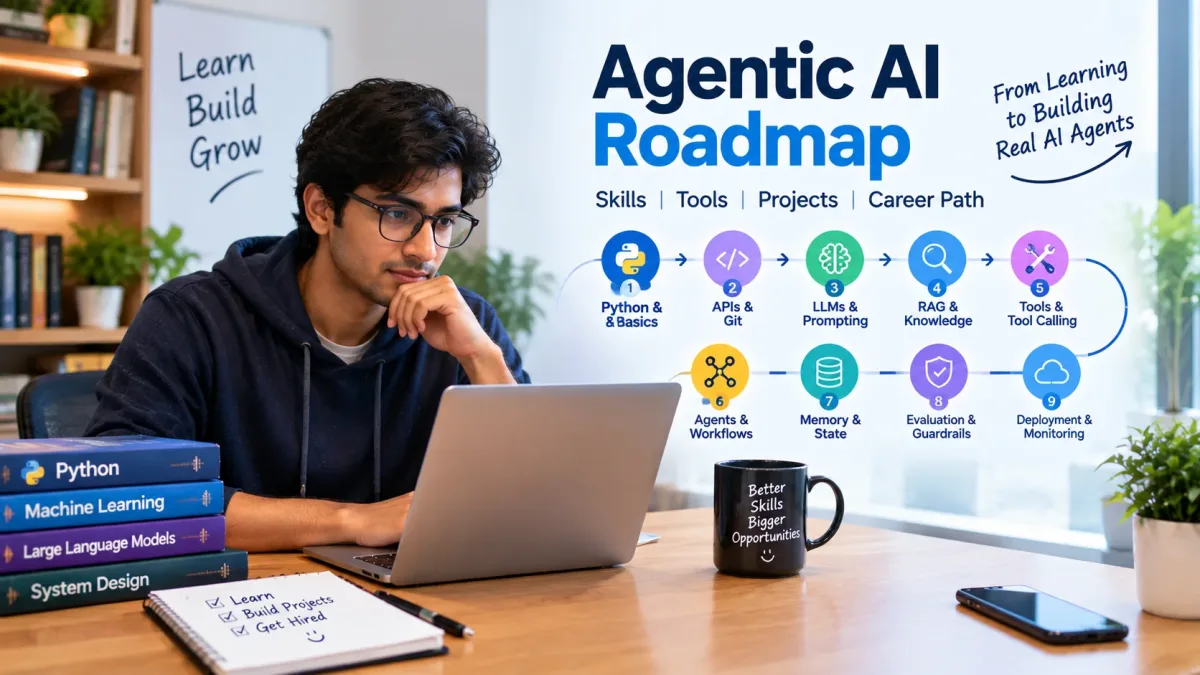
Agentic AI Roadmap: Where Should You Start?
Agentic AI is one of the most interesting developments in artificial intelligence right now. But if you search for an Agentic AI roadmap, you will quickly find a long list of frameworks, models, libraries and buzzwords.
That can make the field look much more complicated than it actually is.
The basic idea is fairly simple: instead of asking an AI model to generate one response, you build a system that can understand a goal, decide what needs to happen, use available tools, work through multiple steps and return a useful result.
For example, a normal chatbot might answer, “Here are some flights to Delhi.” An AI agent could potentially search flight data, compare options against your preferences, ask for confirmation and then carry out an allowed booking workflow.
That difference is the heart of agentic AI: the system does more than generate text; it can participate in a workflow.
This roadmap is designed for students, freshers, software developers, data professionals and AI enthusiasts who want to move from basic AI knowledge to building useful agent-based applications.
What Is Agentic AI?
Agentic AI refers to AI systems designed to pursue a goal through multiple steps rather than simply responding to a single prompt.
An agent may combine several capabilities, such as:
- Understanding natural-language instructions
- Reasoning about the next step
- Calling external tools or APIs
- Searching or retrieving information
- Reading files and structured data
- Maintaining useful state or memory
- Executing multi-step workflows
- Checking results and trying again when appropriate
- Handing important decisions back to a human
The exact architecture varies from one application to another. Some systems use a single agent with several tools, while others use multiple specialized agents working together.
Modern AI development platforms increasingly provide mechanisms for tool use, file search, web search, function calling and agent orchestration, making these capabilities easier for developers to integrate into applications.
Why Learn Agentic AI in 2026?
AI skills are becoming increasingly important across the technology workforce. The World Economic Forum's Future of Jobs Report 2025 identifies AI and big data among the fastest-growing skill areas and lists AI and machine learning specialists among the fastest-growing technology-related roles through 2030.
At the same time, companies are moving from experimenting with AI to integrating it into real business processes. In India, recent industry reporting has highlighted growing demand for advanced AI skills, including generative AI and MLOps, particularly within Global Capability Centres and technology organizations.
Agentic AI sits at the intersection of several valuable areas:
- Software development
- Generative AI
- APIs and backend engineering
- Data and retrieval systems
- Automation
- Cloud deployment
- AI evaluation and reliability
You do not need to master all of these on day one. The goal is to learn them in the right order.
Agentic AI Roadmap at a Glance
Stage What to Learn Main Goal 1 Python & programming Build a solid coding foundation 2 APIs, JSON & Git Understand how applications communicate 3 LLM fundamentals Understand modern AI models 4 Prompting & structured output Control model behaviour 5 Embeddings & RAG Connect AI to external knowledge 6 Tool calling Allow AI to interact with systems 7 Agent workflows Build multi-step AI applications 8 Memory & state Maintain useful context 9 Evaluation & guardrails Make agents reliable and safer 10 Deployment & monitoring Turn projects into real applicationsStep 1: Learn Python Properly
If you want to become an Agentic AI developer, Python is one of the most useful starting points.
You don't need to become a competitive programming expert. Instead, concentrate on the parts of Python you will actually use when building AI applications.
Learn:
- Variables and data types
- Lists, dictionaries and sets
- Functions
- Classes and objects
- Exception handling
- File handling
- Modules and packages
- Virtual environments
- Async programming basics
- Working with JSON
After learning the basics, stop watching tutorials and start building small programs.
For example, create a Python program that reads a JSON file, extracts information, sends a request to an API and saves the response. That simple exercise teaches several skills you will later use inside an AI agent.
Step 2: Understand APIs, Git and Basic Backend Concepts
An AI agent becomes much more useful when it can interact with other software.
That means you need to understand APIs.
Learn how HTTP requests work and become comfortable with:
- GET and POST requests
- REST APIs
- JSON data
- Authentication
- API keys
- Status codes
- Environment variables
You should also learn Git and GitHub. Your projects should not live only on your laptop. A clean GitHub repository with a useful README can make your learning visible to recruiters and hiring managers.
Step 3: Learn How LLMs Work
You don't need to become an AI researcher before building agents, but you should understand the fundamentals of large language models.
Learn what tokens are, how context works, why models sometimes hallucinate, what temperature means, how system instructions differ from user instructions and why model outputs are not automatically reliable.
It is also useful to understand the basic idea behind transformer-based language models without getting stuck in the mathematics.
The goal is practical understanding: you should know what the model is good at, where it can fail and when an external tool or retrieval system is necessary.
Step 4: Master Prompting and Structured Output
Prompt engineering is still useful, but an Agentic AI roadmap should go beyond writing clever prompts.
Learn how to give models clear instructions, define constraints and request predictable output formats.
Structured outputs become particularly important when an AI response needs to be passed to another part of your application.
For example, instead of asking an AI model to describe a customer complaint in free-form text, your application might request structured fields such as:
{ "category": "billing", "priority": "high", "customer_sentiment": "negative", "requires_human_review": true }This makes AI output easier to validate and use programmatically.
Step 5: Learn Embeddings and RAG
One of the first major upgrades from a simple chatbot to a useful AI application is giving the model access to external knowledge.
This is where Retrieval-Augmented Generation (RAG) comes in.
In a typical RAG system, documents are processed into smaller pieces, converted into embeddings and stored in a searchable system. When a user asks a question, relevant information is retrieved and provided to the model as context.
Learn the basic workflow:
- Collect documents
- Clean and split the content
- Create embeddings
- Store vectors
- Search for relevant information
- Send retrieved context to the model
- Generate the final response
RAG becomes especially useful for company knowledge bases, support systems, document assistants, research tools and internal applications.
Step 6: Learn Tool Calling
This is where your applications start feeling genuinely agentic.
Tool calling allows an AI model to request an action from your application. Your application then executes the function and returns the result to the model.
A tool could be something as simple as:
- Checking the weather
- Searching a database
- Looking up an order
- Calculating a value
- Calling a third-party API
- Reading a document
- Creating a support ticket
The model should not automatically be given unlimited access to your systems. Good agent engineering requires clearly defined tools, validation, permissions and appropriate human approval for sensitive actions.
Step 7: Learn Agent Workflows and Orchestration
Once you understand tool calling, start thinking about workflows.
Suppose you are building an AI research assistant. A useful workflow might look like:
User question → understand task → search sources → collect information → analyse results → verify important claims → prepare answer
That is much closer to an agentic workflow than a basic chatbot.
At this stage, learn concepts such as:
- Planning
- Routing
- Tool selection
- State management
- Retries
- Conditional execution
- Human-in-the-loop approval
- Multi-agent workflows
Do not use multiple agents simply because the technology allows it. If one agent and a few well-designed tools solve the problem, that can be a perfectly good architecture.
Step 8: Understand MCP and Tool Connectivity
As agent-based applications become more capable, standardized ways of connecting models to tools and data become increasingly useful.
Model Context Protocol (MCP) is one technology worth learning if you want to work seriously with modern agentic systems.
Instead of creating a completely different integration pattern for every AI application, MCP provides a standardized approach for connecting AI applications with external tools and data sources.
You don't need to memorize every part of the protocol at the beginning. Start by understanding the problem it solves, then build a small MCP-based tool yourself.
Step 9: Learn Memory and State
A useful agent often needs more than the current user message.
For example, a travel-planning assistant may need to remember the user's destination, budget, dates and preferences during a workflow.
Learn the difference between:
- Conversation context
- Short-term state
- Long-term memory
- External application state
- Retrieved knowledge
Be careful with the word “memory.” Storing every conversation forever is not automatically a good design. You need to decide what information is useful, how long it should be retained and what privacy or security requirements apply.
Step 10: Learn Agent Evaluation
This is the stage many beginners skip.
A demo that works once is not necessarily a good AI system.
Agents can make inconsistent decisions, select the wrong tool, retrieve irrelevant information or produce an answer that sounds convincing but is incorrect.
Build an evaluation process for your projects.
For example, create a test dataset containing 50 common user requests and measure:
- Did the agent choose the correct tool?
- Was the retrieved information relevant?
- Was the final answer correct?
- Did the agent follow the expected workflow?
- How many model calls were required?
- How much did each task cost?
- How often did the system need human intervention?
Evaluation, observability and guardrails are becoming important parts of practical agent development. Recent applied-AI training programs in India are also emphasizing RAG, orchestration, multi-agent systems, evaluation, observability, guardrails and deployment rather than prompting alone.
Step 11: Learn Security and Guardrails
The more power you give an AI system, the more carefully you need to control it.
An agent that can only answer questions has limited capabilities. An agent that can send emails, modify records, make purchases or execute code requires much stronger controls.
Learn about:
- Authentication and authorization
- Input validation
- Tool permissions
- Rate limits
- Prompt injection
- Data leakage
- Human approval
- Audit logs
- Sandboxing
In India, the discussion around agentic systems is already extending into areas such as authenticated AI agents and controlled agent-initiated payments, showing why identity, authorization and accountability matter when agents are allowed to take real-world actions.
Step 12: Learn Deployment and Monitoring
Eventually, your agent needs to run somewhere other than your development machine.
You don't need to become a cloud architect immediately, but you should understand the basics of deployment.
Learn:
- Docker fundamentals
- Environment variables
- Cloud deployment basics
- Databases
- Logging
- Monitoring
- API security
- Application performance
- Model and infrastructure costs
Production AI is not just about getting a model to produce a good answer. It is also about reliability, latency, cost, security and maintainability.
Best Agentic AI Tech Stack for Beginners
You do not need to learn every framework available. Start with a small stack and expand when a project requires it.
Area What to Learn Programming Python Version control Git and GitHub LLMs At least one major model API and its concepts Data SQL, JSON and basic databases Retrieval Embeddings, vector search and RAG Agents Tool calling, workflows and orchestration Connectivity MCP and API integrations Backend FastAPI or another suitable framework Deployment Docker and one cloud platform Reliability Evaluation, tracing, monitoring and guardrailsAgentic AI Roadmap for Freshers
If you are a fresher, don't make the mistake of trying to learn everything in one month.
A practical sequence could look like this:
Month 1: Programming Foundation
Focus on Python, Git, JSON, APIs and basic SQL. Build small programs instead of collecting certificates.
Month 2: Generative AI Fundamentals
Learn LLM concepts, prompting, structured output, embeddings and basic model APIs.
Month 3: RAG
Build a document question-answering application. Make it work with PDFs or a small knowledge base.
Month 4: Tool Calling
Add external tools to your application. For example, create an assistant that can search information, calculate values and retrieve records from a database.
Month 5: Agents and Workflows
Build a multi-step workflow with routing, state, retries and human approval where appropriate.
Month 6: Production Project
Deploy your best project. Add authentication, logging, evaluation, error handling and a proper README.
Six months is not a magic deadline. Some learners will move faster, while people starting without programming experience may need more time. The important part is progressing from learning concepts → building projects → testing them → deploying them.
Best Agentic AI Projects to Build
If your goal is employment, projects matter because they give you something concrete to discuss during an interview.
1. AI Research Assistant
Build an assistant that searches approved sources, gathers information, compares findings and produces a cited report.
2. AI Customer Support Agent
Create an agent that retrieves information from a knowledge base, answers customer questions and escalates uncertain cases to a human.
3. AI Resume Screening Assistant
Build a system that extracts structured information from resumes and compares it with a job description. Include human review rather than treating the AI's output as an automatic hiring decision.
4. Personal Finance Information Assistant
Create an educational assistant that categorizes user-provided transactions and answers questions about spending patterns. Avoid giving it unrestricted access to financial accounts.
5. AI Coding Assistant
Build an agent that reads a small codebase, identifies relevant files, suggests changes and runs approved tests in a controlled environment.
6. Multi-Agent Research Workflow
Experiment with specialized roles such as researcher, analyst and reviewer. Compare this design with a simpler single-agent workflow and measure whether the added complexity actually improves results.
What Should You Put on Your Agentic AI Resume?
Don't simply write “Knowledge of Agentic AI” under your skills section.
Show what you actually built.
A stronger project description might look like:
- Built a document-based AI assistant using RAG and vector search.
- Integrated external APIs through structured tool calling.
- Implemented workflow routing, retries and human approval.
- Created an evaluation dataset to measure retrieval and response quality.
- Deployed the application with logging and basic monitoring.
The exact technologies should match what you genuinely used. Never list a framework just because it appears in a popular roadmap.
Do You Need a Computer Science Degree for Agentic AI?
A computer science or engineering background can make the learning curve easier, particularly for software-heavy AI engineering roles. However, the practical skills involved in building agents can be learned from several educational backgrounds.
If you are from BCA, BSc, MCA, engineering, mathematics, statistics, data science or another technical field, you can build toward this area.
Your portfolio becomes especially important if your formal background does not directly match the job.
That means a working application, readable code, documentation and an explanation of your technical decisions can be more useful than simply listing ten AI courses on your resume.
Common Mistakes While Learning Agentic AI
Learning Too Many Frameworks
Frameworks change quickly. Concepts such as tool calling, retrieval, state, evaluation and API integration are more durable.
Building Only Chatbots
A chatbot can be a good first project, but eventually you should build systems that retrieve information, use tools and complete multi-step tasks.
Ignoring Evaluation
If you don't test your agent systematically, you may not know whether a new change actually made it better.
Chasing Every New AI Trend
New models and frameworks appear constantly. You don't need to rebuild your learning plan every week.
Giving Agents Too Much Permission
Start with read-only tools. Add write or transactional capabilities only when you understand the security and approval requirements.
Putting Everything in Your Resume
Five strong projects are usually more useful for an interview than twenty technologies you have only tried once.
Agentic AI vs Generative AI
Generative AI Agentic AI Often focuses on generating content Focuses on completing goals or workflows Usually responds to prompts Can perform multiple steps May operate without external tools Often uses tools and APIs Output may be the final result Output can be one part of a larger process Examples include text and image generation Examples include research, support and automation agentsThe two areas are not competitors. Agentic AI often uses generative AI models as one of its core components.
How Long Does It Take to Learn Agentic AI?
There is no single answer because your starting point matters.
Someone who already knows Python, APIs and backend development can move into agentic systems relatively quickly. Someone completely new to programming will need to spend more time on fundamentals first.
A reasonable learning progression is:
- Beginner: 4–8 weeks to understand the basic concepts and build simple AI applications
- Intermediate: 2–4 months to become comfortable with RAG, tools and agent workflows
- Project-ready: 4–6+ months of consistent practice to build and deploy more complete applications
These are learning estimates, not guarantees of job readiness. Your ability to build, debug and explain real projects matters more than the number of months you have studied.
What Jobs Can You Get After Learning Agentic AI?
Agentic AI knowledge can complement several existing career paths rather than leading to only one job title.
- AI Engineer
- Generative AI Engineer
- AI Application Developer
- Machine Learning Engineer
- Software Engineer – AI
- AI Automation Developer
- LLM Application Developer
- AI Solutions Engineer
- AI Product Engineer
- AI Research or Engineering Intern
Job titles vary significantly between companies. Read the actual job description instead of assuming that the title alone tells you what the role involves.
Agentic AI Roadmap: What to Learn First
If you feel overwhelmed by the number of technologies, remember this order:
Python → APIs → LLM fundamentals → Prompting → RAG → Tool calling → Agent workflows → Memory → Evaluation → Security → Deployment
That sequence gives you a logical foundation.
Don't jump directly into multi-agent systems because they sound advanced. First learn how to build one reliable agent with a few well-defined tools.
Future of Agentic AI
Agentic AI is moving from simple demonstrations toward more controlled, business-oriented applications. Companies are increasingly interested in systems that can connect AI models with existing software, data and workflows.
At the same time, the harder problems are becoming clearer: reliability, security, data quality, evaluation, cost and human oversight.
That means the future of agentic AI is unlikely to be just about writing better prompts. Developers who understand both AI and traditional software engineering will be better positioned to build systems that can actually be used outside a demo environment.
The broader workforce trend supports this combination. The World Economic Forum reports that technological skills such as AI and big data are rising rapidly, while analytical thinking, creative thinking, resilience and lifelong learning remain important alongside technical abilities.
Final Thoughts
Learning Agentic AI can feel confusing because the ecosystem changes so quickly. One week you hear about a new model, the next week there is a new agent framework, protocol or orchestration technique.
You don't need to chase all of them.
Build your foundation first. Learn Python and APIs. Understand how LLMs work. Build a RAG application. Add tools. Turn that application into a multi-step workflow. Then learn evaluation, security and deployment.
Most importantly, build while you learn.
A working AI agent that solves a small real-world problem is far more valuable for your learning than another hundred hours of watching tutorials.
If you are preparing for an AI career, use this Agentic AI roadmap as a direction rather than a strict checklist. Technologies will change, but the underlying engineering skills—problem solving, programming, data handling, system design, evaluation and communication—will continue to matter.
Frequently Asked Questions About Agentic AI Roadmap
What is the best way to start learning Agentic AI?
Start with Python and API fundamentals, then learn LLM concepts, RAG and tool calling. After that, move into agent workflows, evaluation and deployment.
Is Python necessary for Agentic AI?
Python is not the only possible language, but it is one of the most useful choices because of its strong AI and backend ecosystem. JavaScript or TypeScript can also be useful for developers working heavily on web applications.
Do I need to learn machine learning before Agentic AI?
You do not need advanced machine learning knowledge to begin building LLM-based agents. However, understanding basic machine learning and AI concepts will help you understand model behaviour and limitations.
Is RAG necessary for Agentic AI?
Not every agent requires RAG, but understanding retrieval is highly useful because many real applications need access to external or private information.
Should I learn LangChain or another agent framework first?
Learn the underlying concepts first: APIs, tool calling, state, retrieval and workflows. Then choose a framework that makes sense for your project. This makes it easier to adapt when libraries change.
Can freshers learn Agentic AI?
Yes. Freshers can start with Python, APIs and basic generative AI before building increasingly advanced projects. You do not need to begin with complex multi-agent architectures.
What projects are best for an Agentic AI portfolio?
Good projects include research assistants, document agents, customer-support agents, AI automation workflows and coding assistants. Choose projects where you can demonstrate tools, retrieval, evaluation and deployment rather than just a chat interface.
Is Agentic AI the same as an AI chatbot?
No. A chatbot may simply generate a response to a user prompt. An agentic system can be designed to use tools, maintain state, make decisions within defined boundaries and complete multiple steps toward a goal.
Can I get a job after learning Agentic AI?
Learning the technology alone does not guarantee employment. Your chances depend on your overall programming ability, projects, communication skills, experience and the requirements of the specific role.
What should I learn after completing this Agentic AI roadmap?
Once you can build and deploy reliable agents, specialize in an area such as AI engineering, backend development, enterprise automation, RAG systems, AI security, evaluation or AI product engineering.
Suggested Internal Links for TechNaukary
- AI Jobs: Link to your latest AI job listings.
- Gen AI Jobs: Link to your detailed generative AI career guide.
- AI Jobs for Freshers: Link to your fresher-focused AI jobs article.
- IT Jobs for Freshers: Link to relevant entry-level technology jobs.
- Resume Builder / ATS Checker: Link from the resume section.
- AI Interview Questions: Link from the interview preparation section.
- Work From Home Jobs: Link where discussing remote AI opportunities.
Cover Image Concept
Recommended image: A realistic young Indian technology professional learning Agentic AI at a modern desk, with a laptop showing a clean AI-agent workflow diagram containing nodes for LLM, RAG, tools, APIs, memory, evaluation and deployment. Subtle visual elements representing Python, APIs, automation and multi-agent workflows; professional blue/white technology theme; clean editorial composition; optimistic but realistic career-learning atmosphere; wide 16:9 blog hero image; no excessive futuristic effects.
Recommended cover image text: “Agentic AI Roadmap” with a smaller subtitle such as “Skills, Tools, Projects & Career Path”.